

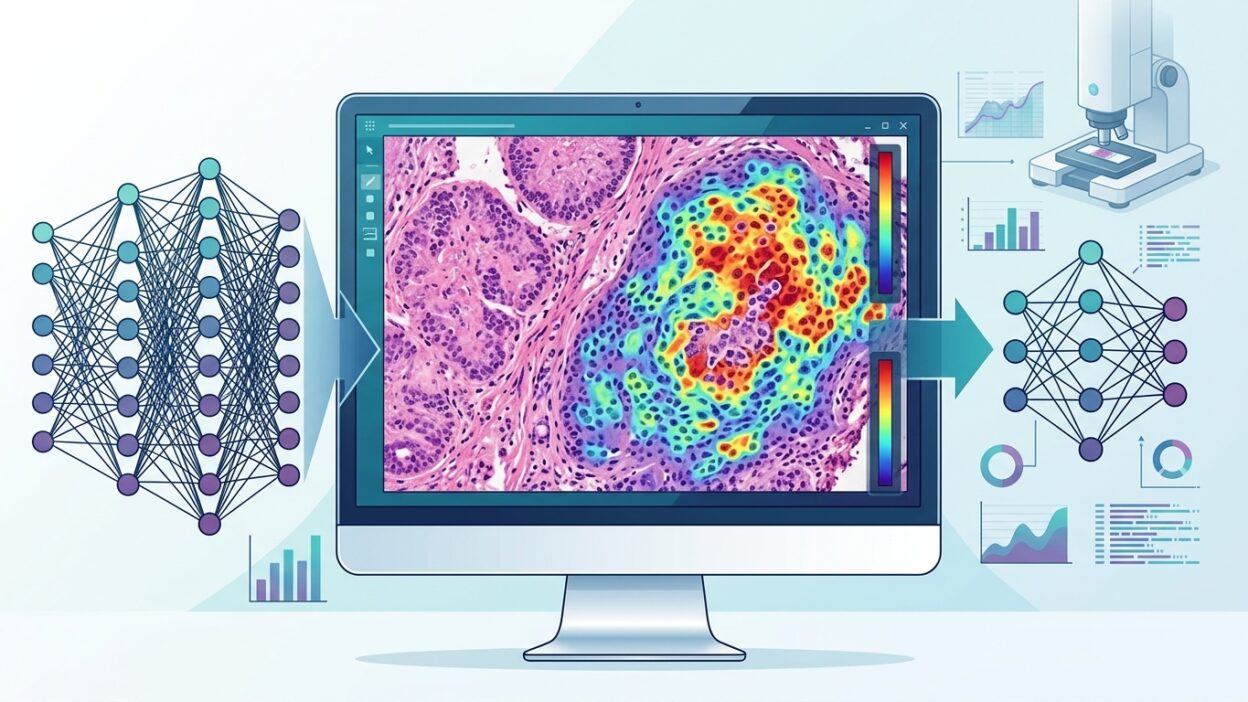
Imagine having thousands of WSI cases in a research project and wanting to run a pathology Foundation Model across all of them. The idea sounds good on paper. In practice, the first question is simple: how much GPU do we need, and how long will this take?
That is the problem a new paper from Microsoft Research and Providence tries to address with two models: GigaPath-Flash and GigaTIME-Flash.
The point is not to introduce a larger model. It is the opposite. The team is trying to keep much of the strength of the original GigaPath model, but in a smaller system that is easier to test at whole-slide level.
What is GigaPath-Flash?
GigaPath-Flash uses a 22M-parameter ViT-S tile encoder and a 21M-parameter LongNet slide encoder. The original GigaPath model used a ViT-g encoder with roughly one billion parameters. That can produce strong results, but large-scale use becomes expensive quickly.
The researchers used distillation to move knowledge from the larger model into the smaller encoder. According to the paper, GigaPath-Flash retained 97% of GigaPath’s average slide-level performance while using 50 times less compute.
For a pathologist or a research team working with real WSI data, that matters. Not because the model is ready for direct diagnosis, but because testing becomes more realistic. Instead of requiring a large GPU budget, more labs can try the model on local cohorts.
What about GigaTIME-Flash?
GigaTIME-Flash uses the same lighter encoder for a different task: predicting signals related to the Tumor Immune Microenvironment from routine H&E images.
This is a careful but interesting direction. H&E is the everyday image every pathologist knows. If a model can extract signals related to spatial proteomics or immune microenvironment from H&E, it may help research, triage, and hypothesis generation before moving to more expensive assays.
According to the paper, GigaTIME-Flash outperformed the older CNN-based GigaTIME model in prediction quality, while running 6 times faster and using 8 times less GPU memory.
Where is the practical value?
The value is not replacing molecular or immunologic testing. The paper should not be read that way.
The nearer value is that WSI and Tumor Microenvironment models are moving from “large model that is hard to run” toward “model that can actually be tested.” That is a major difference in digital pathology, where many good ideas hit a wall at data scale and compute cost.
The open-weight Apache-2.0 release also matters. Research groups outside large companies can download the models, test them, and build independent validation on data from different settings.
What does this mean for pathologists?
The message is not that AI will read the slide for you tomorrow. The more realistic message is that WSI analysis tools are becoming lighter and closer to real research workflows, and possibly later to assistive clinical workflows after serious validation.
The key question now is whether the performance holds across hospitals, scanners, staining conditions, and tissue preparation workflows. That is where the real test begins.
For now, GigaPath-Flash and GigaTIME-Flash offer a practical shift: performance close to a larger model, with far lower compute. That is exactly what digital pathology needs if it is going to move from impressive demos to reproducible work in more labs.