

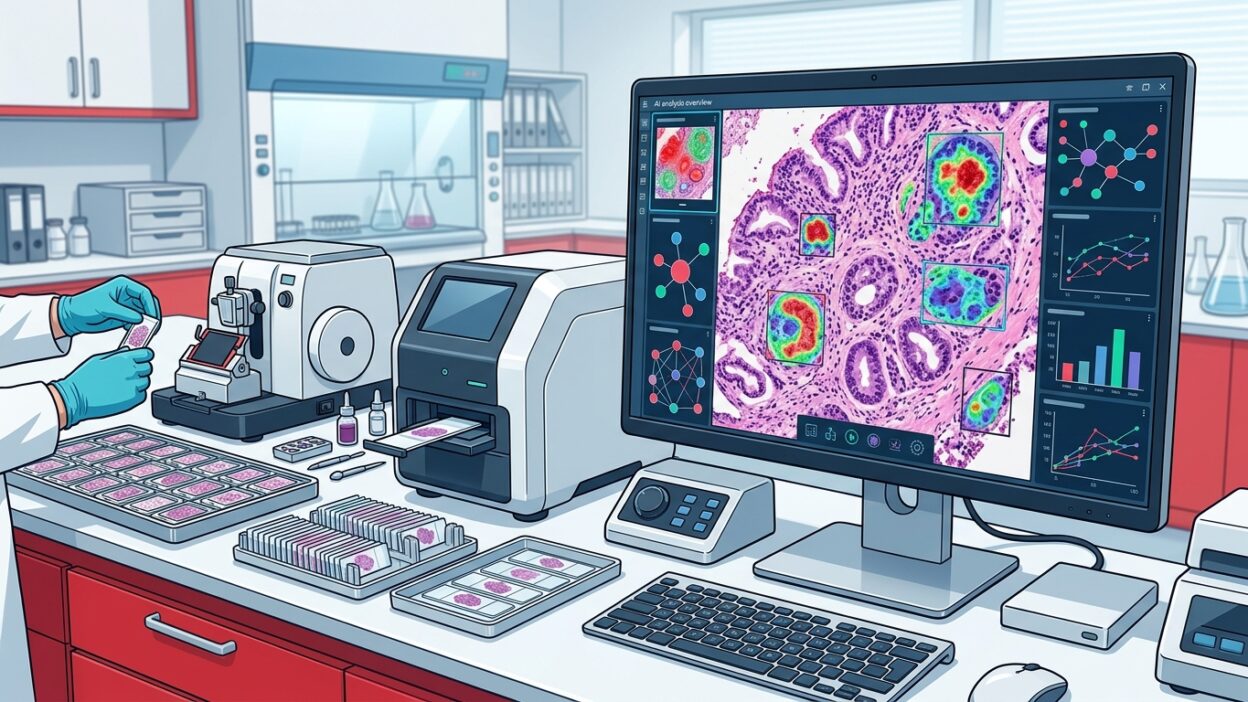
Every AI model in pathology starts with something far less glamorous than an algorithm: a properly handled specimen, controlled tissue processing, a clean section, a reproducible stain, and a slide that can be trusted. That is why Leica Biosystems’ plan to acquire StatLab is not only a corporate transaction. It touches the part of the workflow that comes before WSI and computational pathology.
Leica Biosystems, a Danaher operating company, announced that it has signed a definitive agreement to acquire privately held StatLab Medical Products from Linden Capital Partners and Audax Private Equity. The transaction is expected to close by the end of 2026, subject to customary conditions and regulatory clearances. Financial terms were not disclosed.
What StatLab adds
StatLab has worked for more than 50 years in anatomic pathology products, with a portfolio that covers specimen collection, tissue processing, slide preparation, staining, and other histology supplies. These are everyday parts of the lab. They rarely get the same attention as scanners or AI dashboards, but they shape the image that the pathologist eventually sees on the microscope or on a digital slide viewer.
Leica already has a strong footprint in anatomic pathology and digital pathology, including instruments, staining, imaging, and Aperio digital pathology solutions. Bringing StatLab into Leica expands the company’s reach across more of the sample-to-slide chain, not only the imaging and software layer.
Why pathologists should care
When AI in pathology is discussed, the conversation often jumps to model architecture, datasets, sensitivity, and specificity. In daily laboratory work, the risk starts earlier. Pre-analytic variation, fixation differences, staining drift, and section quality can make an AI model look strong in a paper but less stable in routine use.
Leica’s own statement linked the deal to consistency, standardization, and quality as requirements for AI-enabled cancer diagnostics at scale. That is the key point. AI adoption in pathology is not just a scanner purchase or a software subscription. It depends on laboratories that can produce slides with predictable quality.
For the practicing pathologist, this signals a broader industry view: AI is becoming part of a full diagnostic production line. The algorithm sits at the end, but it depends on consumables, instruments, QC, digital imaging, and workflow discipline before it can be trusted clinically.
What to watch
The deal still needs regulatory clearance and is not expected to close until the end of 2026. The practical question is how Leica will integrate StatLab products with its current portfolio. Will this remain a commercial expansion, or will it lead to tighter QC protocols and histology standards that connect directly with digital pathology platforms?
Smaller and mid-sized laboratories should watch the commercial side as well. If consolidation leads to expensive closed bundles, the benefit may be limited. If it improves access, training, and standardization in histology workflow, it could help labs that are moving gradually toward WSI and AI tools.
The bottom line for pathologists is simple: this is not an AI announcement in the narrow sense. It is about the ground AI stands on. Slide quality, stain consistency, and pre-analytic control will remain decisive even when the final interface becomes digital and AI-enabled.