

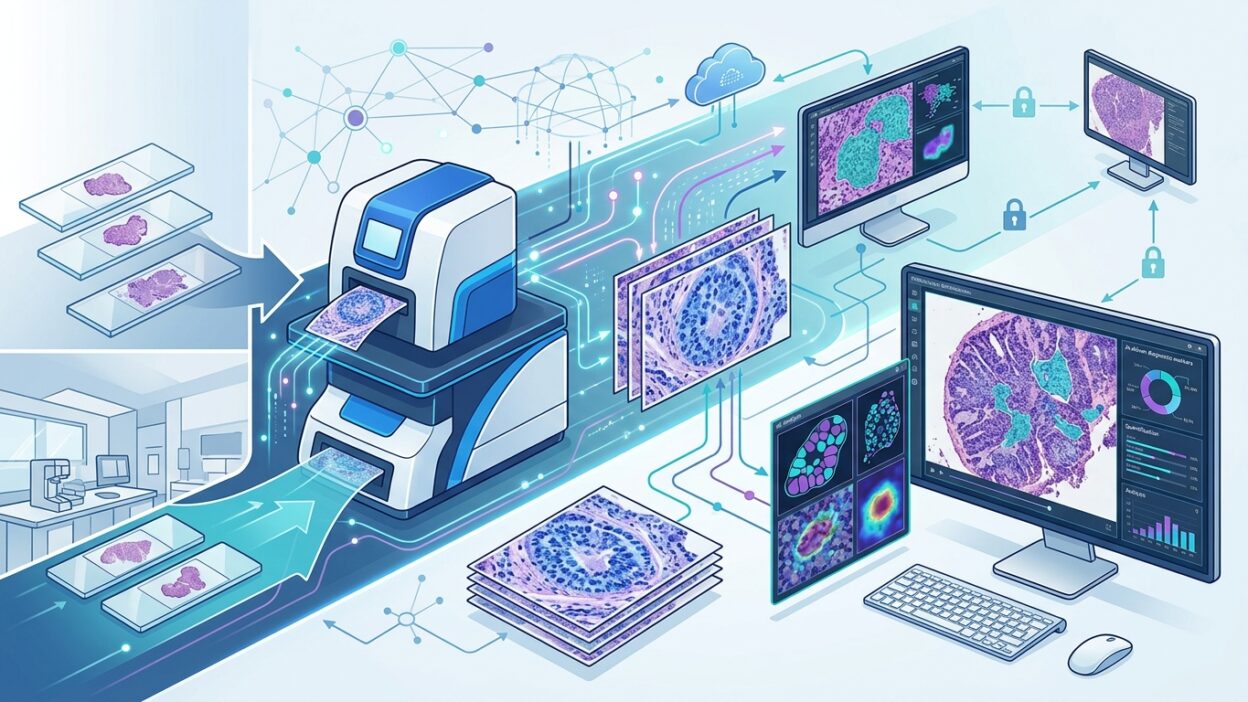
In many histopathology departments, digital slides have become familiar in teaching, meetings, archiving, or internal case review. But when a second opinion is requested outside the hospital, the workflow sometimes returns to an old scene: a box of slides, packaging, a courier company, and then waiting.
The article by Patrick Myles from PathPresenter asks a practical and uncomfortable question: why are we still shipping glass slides in 2026? Its importance is not that it advertises a digital platform. It matters because it touches a daily point known to every pathologist who has dealt with external consultations. Delay does not always happen because the diagnosis is difficult. It happens because the specimen itself, or its glass representation, is still moving outside the information system.
The second opinion starts with logistics before the microscope
In rare tumors, morphologically overlapping cases, or specimens that need subspecialty review, external consultation becomes part of treatment-decision quality. The referring physician wants a reliable answer. The patient waits for a treatment plan. The clinical team builds its next steps on a report that may be delayed for days simply because the slides are in transit.
The article notes that external consultation can take 5 to 14 days in workflows that depend on shipping. That interval does not reflect reading time alone. It includes slide preparation, patient-data entry, packaging, transport, receipt, matching, registration in another system, and then return of slides or requests for additional sections and stains. Each step looks small, but each adds delay and risk.
The problem is larger than a lost slide or a delayed package. Clinical context is repeatedly interrupted. Clinical data may arrive in a format different from the original laboratory data. Radiology images may sit elsewhere. IHC or molecular results may arrive later. The pathologist reviewing the case needs to see the full story, not chase its pieces across email, a PDF file, and a temporary sharing link.
Imaging alone is not enough
A common mistake in digital transformation projects is reducing digital consultation to producing a WSI and sending a link. This solves part of the problem, but it leaves the clinical work itself outside control. Without a clear request pathway, controlled access permissions, an audit trail, and LIS integration, digital sharing becomes a faster version of paper disorder.
From the pathologist’s perspective, the practical question is simple: can I open the case, see the slides, stains, and clinical data, understand exactly what I am being asked to answer, write my opinion, and review its effect inside a documented workflow? If the answer is no, the platform is only showing images. And an image, however good, does not create a full consultation service.
That is why the article focuses on elements such as secure collaboration, PHI support, structured consultation pathways, audit logs, LIS integration, and asynchronous work between institutions. These are not side technical details. They are the difference between using WSI as a viewable file and using it as part of a diagnostic service that can be defended professionally and regulatory.
What does this mean for laboratories?
The first direct effect is turnaround time. When the digital case reaches the subspecialist within minutes, the discussion moves from shipping to diagnostic quality: are the slides representative? Are the stains sufficient? Do we need another level or a molecular test? These are the questions that should consume the team’s time, not tracking a slide box.
The second effect is expertise distribution. Not every hospital can have a subspecialist for every rare tumor type. But health networks can bring expertise closer if the consultation pathway is built on digital images and organized data. This matters especially for referral hospitals and centers serving remote regions, where delay means extra days before treatment starts or before the patient is transferred.
The third effect is administrative and legal. External consultation is not an informal chat between colleagues. It is a professional act that needs clear responsibility, data preservation, and documentation of what was reviewed, who reviewed it, and when. Sharing files through general tools may look convenient at first, but it leaves difficult questions during audit: who opened the file? Was the version correct? Was the opinion linked to the right record? Can the pathway be reconstructed after a year?
The barrier is not only pathologists’ acceptance
Many pathologists are convinced of the value of digital consultations, but implementation runs into familiar details: scanner cost, storage, network speed, format compatibility, staff training, and convincing management that the project is not just the purchase of a new device. There is also the workload question. Should all consultation cases be digitized? Should the laboratory start with one case type? Who is responsible for image quality control before sending?
The practical choice often starts with a narrow and clear pathway. For example: complex breast tumor consultations, CNS cases, lymphoma, or referral cases from a peripheral hospital to an academic center. When turnaround time, repeat-shipping events, and the proportion of cases needing additional slides are measured, the discussion with management becomes calmer and more tied to real work.
There is also a point vendors usually do not like: laboratories do not live inside one system. The scanner may come from one company, storage from another, the LIS from a third vendor, and AI tools from a fourth. Any digital consultation model that does not handle this reality will create a new bottleneck. Interoperability and clear integration become more important than a pretty viewing interface.
Glass will remain, but its role has to change
This does not mean the glass slide will disappear from the laboratory soon. It will remain a physical source for diagnosis, archival material, and a reference when needed. But relying on the movement of glass between cities and countries for second opinions no longer fits the current workload or the expectations of patients and clinical teams.
The needed shift is simpler than the big slogans: digitize the right cases, connect them to the right data, send them through a documented pathway, and allow a subspecialist to give a traceable opinion in less time. This does not remove professional judgment. It removes layers of waiting around it that add no diagnostic value.
For the practicing pathologist, the message is practical. If your department regularly sends slides for external consultation, start by measuring the time lost outside the microscope: from the moment the second opinion is requested to the moment the case reaches the reviewer. You will often find that the problem does not live in the diagnosis, but in the route the slide takes before reaching the person who can resolve it.
Source: PathPresenter, republished by Pathology News under the title Why Are We Still Shipping Glass Slides in 2026?