

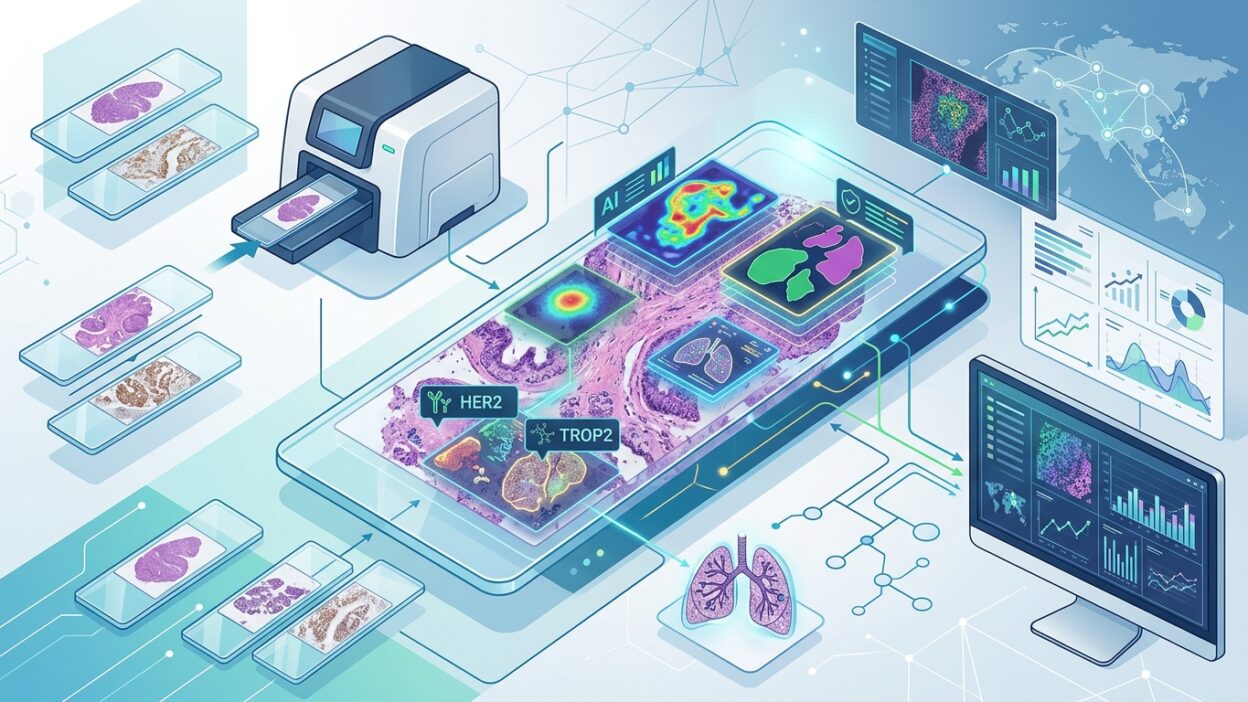
AstraZeneca and Roche Diagnostics Asia Pacific announced a three-year memorandum of understanding to support the use of digital and computational pathology across nine Asian markets: Singapore, Taiwan, Korea, Thailand, Malaysia, India, Indonesia, Vietnam, and the Philippines. The announcement focuses on training, education, and the introduction of AI tools linked to diagnostic workflows in breast and lung cancer.
This is worth professional attention because it puts pathology in its correct place within precision oncology: before treatment selection, before prescribing ADCs, and before any discussion of HER2-low or TROP2. If laboratories still have gaps in preparation, scanning, quality control, and linking results to the clinical record, a single AI model will not solve diagnostic workflow problems. The value of this partnership is in building a usable workflow across laboratories with unequal resources, not in the announcement itself.
Why this matters to pathologists
The companies note that around half of breast cancer cases and more than 60% of new lung cancer cases worldwide occur in Asia. In that context, biomarker testing quality becomes a daily clinical issue, not a side research project. In breast cancer, more attention is now placed on identifying HER2-low more accurately, because an error in the grey zone may keep a patient away from a suitable treatment option. In lung cancer, TROP2 is reported in a high proportion of NSCLC cases in the statement, with growing interest in linking it to ADC therapies and AI-supported companion testing.
This creates practical pressure on pathology departments. The diagnostic report is no longer only a histologic type, grade, and stage of a specimen. It is part of a treatment decision that depends on staining intensity, staining pattern, heterogeneity, cutoffs, specimen quality, and possibly a digital reading method that can be reviewed later. Any expansion of digital pathology has to protect this whole chain.
The numbers need careful reading
The statement says that only 17% of physicians consider themselves highly knowledgeable about advanced pathology technologies, and that use of computational pathology tests in clinical practice remains low. It also says that 60% of oncologists in the Philippines reported that the lack of biomarker testing had hindered their practice. These numbers do not describe a technical problem only. They describe a gap between what modern cancer treatment requires and what laboratories can deliver consistently.
AI performance numbers need precision, though. The statement says AI-supported workflows may increase diagnostic accuracy by up to 5%, reduce case reading time by 36%, improve interpretation concordance by up to 15%, and reclassify 24% of cases previously labelled HER2-negative as HER2-low. These are encouraging results, but they are not enough by themselves to change the practice of a whole laboratory. A pathologist needs to know the specimen type, protocol, scanner platform, ground truth standard, cutoffs, and time-measurement method before deciding what these percentages mean in their own department.
HER2-low is not a small detail
In breast cancer, HER2-low interpretation sits in a sensitive area between immunohistochemistry, individual experience, and workload pressure. The difference between 0 and 1+, or between 1+ and 2+ with an appropriate ISH result, may look small on the slide, but it is now linked to specific treatment options. Digital reading can add value here if it provides more stable measurement, archiving of the reviewed image, and internal review when results differ.
The problem is that a digital tool can add a new layer of confusion if it enters the workflow without prior control. The laboratory has to know how it will handle scanner differences, staining-intensity variation, necrotic areas, low tumor cellularity, and fixation effects. A clean digital score means little if the pre-analytic process is not controlled. Pathologists know this point well, but it returns strongly whenever an algorithm enters IHC interpretation.
TROP2 and the ADC file in lung cancer
In NSCLC, TROP2 gives another example of biomarkers moving from the research column into treatment decisions. The statement reports TROP2 expression in 82 to 90% of NSCLC cases and links AI-supported assessment with identifying patients more likely to respond to ADC therapies. For laboratories, this means more than simply offering a new stain.
The practical questions are direct. Who reviews borderline cases? How are reading regions documented? Is the WSI saved with the report? What is the reread plan when the protocol or software version changes? And how is the result explained to the oncology team without giving the algorithm more authority than the clinical evidence supports? These questions should accompany any training program in the nine named markets.
Training matters more than buying the platform
A weak point in many digital transformation programs is the assumption that buying the scanner or licensing the software is enough. The announcement refers to education and training initiatives tailored to the needs of each local health system. That detail is good if it is applied seriously. A laboratory in Singapore does not face the same barriers as a laboratory in the Philippines, Vietnam, or Indonesia. Infrastructure, test reimbursement, specialist availability, and internet speed all affect the final result.
From the pathologist’s side, the needed training must go beyond a sales demonstration. It should include difficult case reading, review of inter-reader variation, accreditation requirements, data security, LIS integration, and a policy for system failure during daily work. Without these details, digital pathology becomes another layer on top of an already tired workflow.
What should a department ask for before starting?
Any department considering a similar pathway needs a clear baseline. How many HER2 and TROP2 cases are read each month? What is the restain rate? How often do pathologists disagree? How long does the report take from slide receipt to sign-out? What proportion of cases are delayed because slides are sent out or testing is unavailable? Without these numbers, the effect of any digital solution after installation is hard to measure.
Local validation comes next. Published numbers or a press release are not enough. Performance has to be tested on the department’s own specimens, with its stains, scanners, and the pathologists who will sign the reports. The department also has to define which cases can use computer-supported reading and which cases need full manual review. This protects the patient and the pathologist.
A professional reading of the announcement
A partnership between a pharmaceutical company and a diagnostics company in this area makes sense. Targeted therapy needs reliable testing, and reliable testing needs a laboratory capable of producing reproducible results. But the pathologist has to remain the guardian of quality, not a passive user of a ready-made system. The real value appears when access gaps in biomarker testing shrink, case review becomes easier to audit, and treatment decisions rest on documented results that can be defended.
For pathology departments in the Arab region, the announcement offers a direct lesson. Digital pathology does not start with AI. It starts by identifying the tests that most affect treatment, then building a controlled digital workflow around them. HER2 and TROP2 are clear examples because an error in either can change the treatment path of a real patient. That is enough to make the discussion practical, away from the usual exaggeration around technology news.
Source: PR Newswire statement on the AstraZeneca and Roche Diagnostics Asia Pacific partnership.