

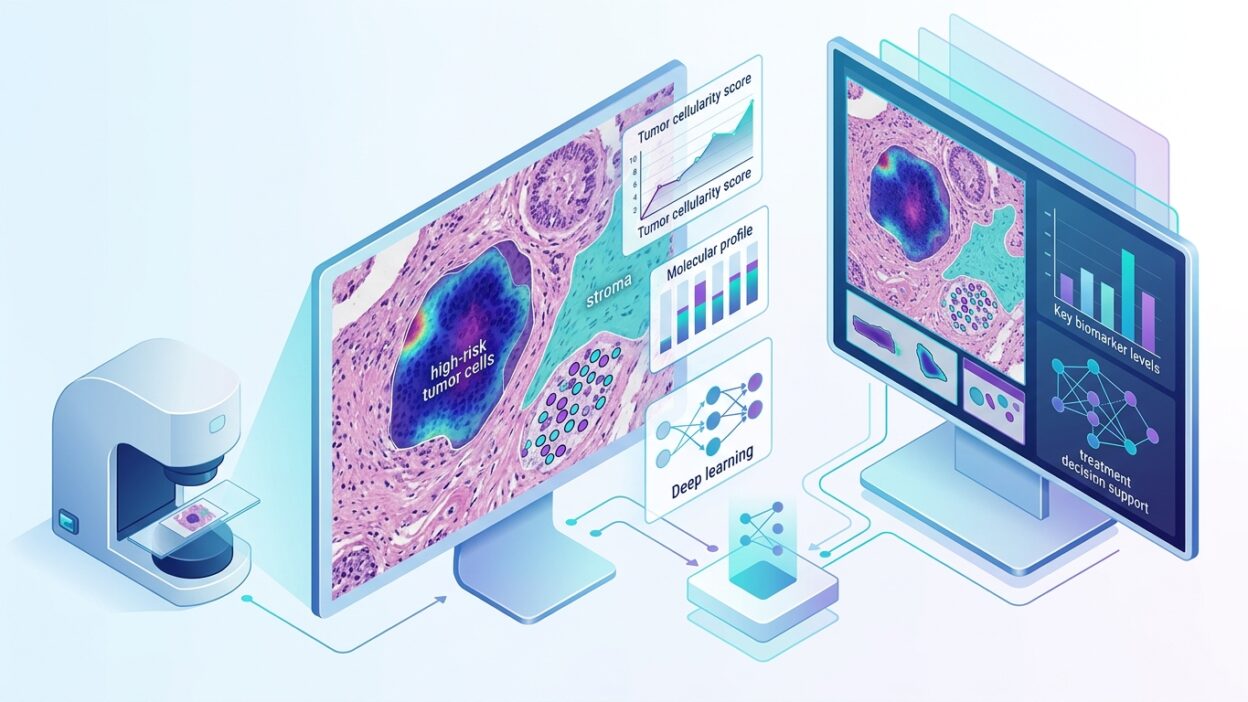
The article published in Beyond the Slide about “The Translation Gap” raises a problem many pathologists know from inside the laboratory, not from conference halls: the biological signal may be valid, the spatial image convincing, and the histologic validation present, yet everything stops at a point simpler than the algorithm. A contaminated sample, a slow workflow, an information system that does not know what to do with the result, or a clinical team that does not receive the information in time.
This is not a problem for technology companies alone. In digital pathology, spatial assays, and WSI-based predictive models, the same story repeats. We generate signals that are more precise than the clinical organization can absorb. The gap is not only between the laboratory and the patient. It sits inside the institution itself, between discovery and validation, between validation and reporting, and between the report and the treatment decision.
A biomarker is not enough if it stays outside the workflow
The article opens with a familiar case: a group working on spatial transcriptomics data from about twenty samples, with a clear biological signature, historical correlations, and confirmation by IHC. The paper is almost ready, but the final sample becomes contaminated. The result does not collapse scientifically, but it stalls in practice. Waiting another month may look like a small detail in a research project, but in clinical development it means a delayed decision, a changed trial schedule, and perhaps the loss of a time window that will not return.
A pathologist recognizes this pattern quickly, because daily practice sits between sample quality, preparation time, system limits, and the clinician’s question: can I use this result now? The technology may be excellent, but the medical decision does not wait for the paper. The decision needs a result that is understandable, documented, reportable or usable in a tumor board, and connected to a defined treatment step.
Medicine was built on reducing signals
Clinical medicine has long converted complex biology into actionable categories. TNM, Gleason, IHC expression scores, laboratory cutoffs, and response classifications. This is not naive simplification. It is a necessary way to work, because the physician needs a decision within a limited time.
The problem is that AI and spatial biology produce a different kind of signal. We are not dealing only with positive and negative, or low and high. We are dealing with thousands of genes in their tissue location, relationships between immune cells and stroma, and models that learn from millions of histology patches and return a risk score or a probability of response. These outputs do not fit easily into older reporting templates.
Here the practical question appears: where will the result show up? In the pathology report? In the LIS? In the EHR? In the tumor board? And who is responsible for interpreting it when it conflicts with the conventional histologic impression or with a single marker such as p53 or Ki-67?
Failure examples do not mean the algorithms have no value
The article presents examples from outside pathology that still matter to us. Epic’s sepsis prediction model showed an internal AUC of 0.83, but external validation at the University of Michigan found that real-world sensitivity was 33%. The problem was not just a number. It was an alerting system that produced so many warnings that staff began to ignore them.
IBM Watson for Oncology is another example. The goal was to provide personalized oncology treatment recommendations, but training on hypothetical cases is not the same as dealing with real patients and their clinical, histologic, and molecular variation. When evaluated at the Danish National Cancer Center, Watson agreed with local clinical judgment in only 33% of cases. The number is painful, but it makes one point clear: a model that does not know the environment where it will be used will struggle at the first real contact with that environment.
The Google Health experience with diabetic retinopathy screening in Thailand is closer to digital pathology than it may seem. Algorithm performance was high, but differences in lighting and imaging devices led to rejection of more than 20% of images as unsuitable. The result was repeat imaging, congestion, and slower work. In the histology lab, the same thing can happen with differences in scanners, section thickness, staining quality, or region selection.
In digital pathology, the problem is often operational
In WSI projects, we tend to ask first about model accuracy. That makes sense, but it is not enough. The next question matters more inside the laboratory: does the result work within the timing of daily practice? If the model requires rescanning, produces a long list of alerts, or asks the pathologist to open a separate platform, the chance that it will be left at the margin rises even when its statistical performance is good.
Clinical adoption needs a complete chain: an appropriate sample, stable scanning, quality control, a versioned model, an audit trail, clear outputs, a way for the pathologist to accept or challenge the result, and a link to the clinical decision. Every weak link adds friction. With repeated friction, the system changes from a useful tool into administrative work.
This matters especially for composite biomarkers: a spatial signature that predicts response, a model that estimates survival from WSI and genomics, or a map of cell interactions in the tumor microenvironment. If the team does not know where to place this result in the patient pathway, it will remain an attractive result in a slide deck or a research supplement.
What does this mean for the pathologist?
The professional role is not limited to reviewing images or approving a model output. The pathologist should be part of designing the intended-use pathway from the beginning. What sample type is acceptable? What is the scanner failure threshold? What output format can enter a report? Is the result descriptive, predictive, or linked to a treatment option? What happens when the model conflicts with the microscopic impression?
These questions may sound administrative, but they are diagnostic quality questions. A model without answers to them is not ready for practice, even if it was published in a strong journal. The reverse is also true: a model with only moderate statistical performance, but placed at the right point in the workflow, with clear monitoring and explicit limits of use, may change a clinical decision more than a high-performing system that stays outside the report.
What should laboratories ask vendors and research teams?
When evaluating any AI platform or spatial analysis tool, the discussion should go beyond AUC, Dice, and concordance. Ask about turnaround time from slide receipt to result. Ask about image failure, scanner differences, and drift monitoring over time. Ask where the output appears inside the LIS or EHR, who sees the result, and how the pathologist’s approval or objection is documented.
Ask also about the specific clinical value. Does the model change the choice of an additional test? Does it shorten the time needed to discuss the case? Does it improve agreement between pathologists? Does it reduce rework? If there is no specific answer, the risk is that the project becomes an attractive experiment with no effect on the patient report.
The action point for the laboratory
The value of AI in pathology does not appear only when it produces a new signal. It appears when that signal reaches the pathologist and treating physician at a moment when it can change the decision. The article reminds us that failure can happen after the science succeeds, not before.
Any digital project should therefore start with a simple question: who will use this result, at what minute of their day, and with what clinical authority? If we cannot answer, the problem is not the model alone. It is the route between the slide and the decision.