

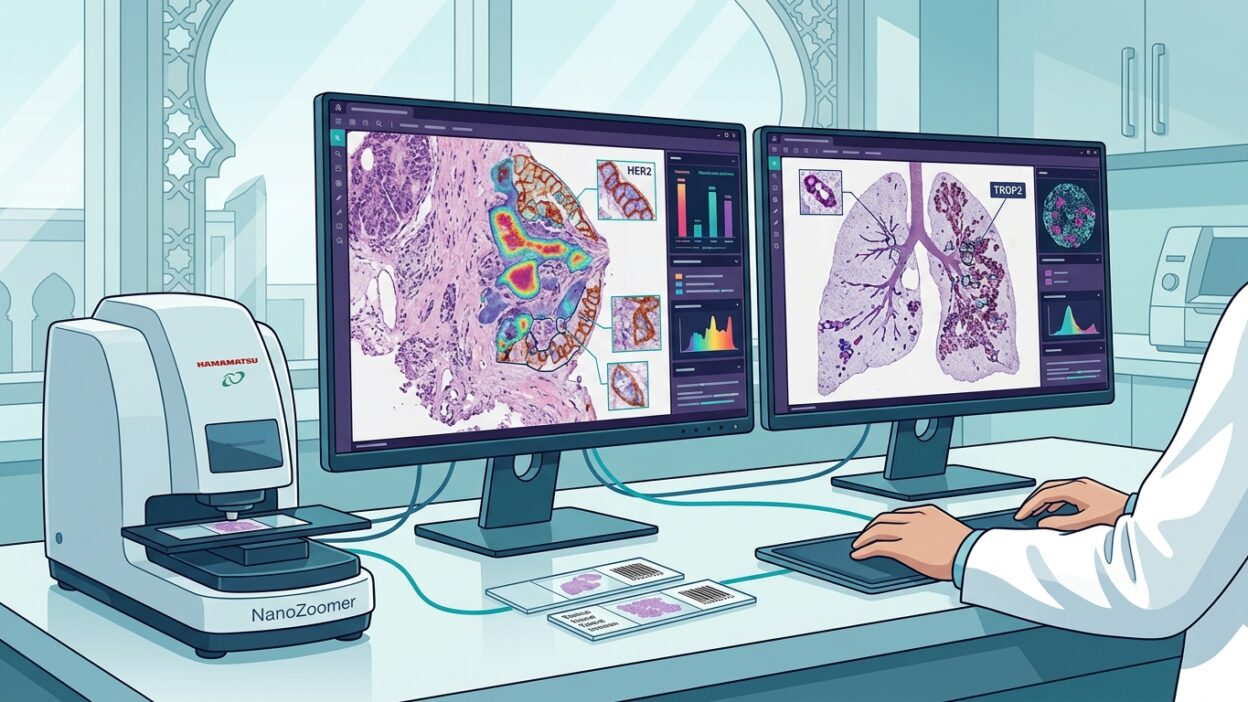
AstraZeneca and Roche Diagnostics Asia Pacific announced a three-year memorandum of understanding to support digital pathology and artificial intelligence capabilities in nine Asian markets: Singapore, Taiwan, Korea, Thailand, Malaysia, India, Indonesia, Vietnam, and the Philippines. At first glance, the news looks like a commercial partnership between two large companies. The details, however, touch the daily work of pathology laboratories more than the wording of the press release suggests.
The agreement centers on training, education, and adoption of digital and computational pathology tools, with a clear focus on breast cancer, lung cancer, and biomarker tests that guide treatment decisions. This is a sensitive point that needs little explanation for any pathologist working with HER2, TROP2, or similar markers. Clinical value does not begin at the treatment report. It begins with the accuracy, consistency, and reproducibility of interpretation across laboratories.
The news in brief
The partnership runs for three years and aims to support the introduction of digital tools and AI into diagnostic pathways through education, training, and alignment with the local needs of each health system. According to the published statement, the initiative is taking place in a region that carries a large share of the global cancer burden: nearly half of breast cancer cases and more than 60% of new lung cancer diagnoses occur in Asia.
The statement also notes that nearly half of Asian women with breast cancer may show low HER2 levels, and that TROP2 is present in 82% to 90% of non-small cell lung cancer cases. These figures put histology, immunohistochemistry, and digital interpretation in a very practical position. Any weakness in consistency or access can affect whether a patient is considered eligible for targeted therapy or an antibody-drug conjugate.
The problem is not the algorithm alone
One important figure in the statement is that only 17% of physicians consider themselves highly familiar with advanced pathology technologies, alongside low use of computational testing in clinical settings. The statement also cited that 60% of oncologists in the Philippines reported that lack of access to biomarker testing had hindered their practice.
These numbers expose a familiar gap in laboratories. Buying a scanner or connecting it to a viewing system is not enough. If specimen flow, quality control, reader training, image acceptance policy, and documentation of algorithm output do not change, the technology remains outside clinical decision-making. Any serious training program should therefore start inside the laboratory, not with a platform sales demonstration.
HER2-low and TROP2 raise the bar for review
In breast cancer, HER2 classification is no longer just a broad separation between positive and negative in many treatment scenarios. The HER2-low category has made borderline interpretation more important, especially when a result sits close to practical thresholds that affect ADC selection. Here, agreement between readers and between laboratories becomes part of decision safety, not an administrative improvement.
In non-small cell lung cancer, discussion of AI-supported TROP2 assessment opens a different question. An algorithm does not remove the pathologist’s judgment, but it may help reduce variation in quantitative assessment and identify cases that need closer review. The practical difference appears in gray-zone cases, not in obvious cases where everyone agrees.
The statement refers to studies suggesting that AI-supported workflows may improve diagnostic accuracy by up to 5%, reduce case reading time by 36%, and increase interpretive agreement by up to 15%. It also mentions reclassification of 24% of cases previously labeled HER2-negative into the HER2-low category. These figures need critical reading according to study design and context, but they are enough to explain why laboratories and oncology teams are paying attention.
What should pathologists ask of any similar program?
The first requirement is clarity. Which specimen type does the tool apply to? Which stain? Which scanner? Which software version? What are the limits of use inside the report? A computational tool cannot be added to a sensitive diagnostic pathway without a precise definition of its scope.
The second requirement is local measurement. Published performance does not replace validation inside the laboratory, especially when preparation, tissue type, staining quality, and scanner performance vary. The team should see the tool’s results on its own material and on the cases known to cause disagreement between readers.
The third requirement is governance. Who reviews the algorithm output? How is the result recorded? When can the pathologist override it? How should processing failure or an unacceptable image be handled? These are practical questions, but they determine the success of the program more than the vendor’s name.
Where does the agreement matter?
Its real importance is that the partnership is not talking about a single device or a single test only. It is about building the usable capacity for digital pathology within health systems that differ widely in resources. Asia is not one market. A laboratory in Singapore is not the same as a laboratory in the Philippines or Vietnam in funding, workforce, informatics connectivity, or molecular testing capacity. For that reason, the phrase local needs, if applied seriously, is the most important part of the announcement.
From a pathologist’s perspective, the success of initiatives like this will be measured by three points: did access to biomarker testing increase, did interpretation become more consistent in borderline cases, and did the results enter treatment decisions without slowing the pathway? If these points are not met, digital pathology will remain a useful side project rather than a clinical tool that teams rely on.
The practical takeaway for laboratories
This agreement reminds us that the future of HER2 and TROP2 testing will not be limited to stain quality or reader expertise alone. The entire pathway will come under review: from slide and image, to algorithm, to report, to tumor board. That chain cannot tolerate a weak link.
For laboratories considering AI adoption, the starting point is not asking the vendor which interface looks best. The starting point is choosing a defined clinical use case, building local validation, training the team, and connecting the result to a clear treatment pathway. Only then does digital pathology become part of pathology practice rather than a technical display outside it.
Source: PR Newswire / AstraZeneca.