

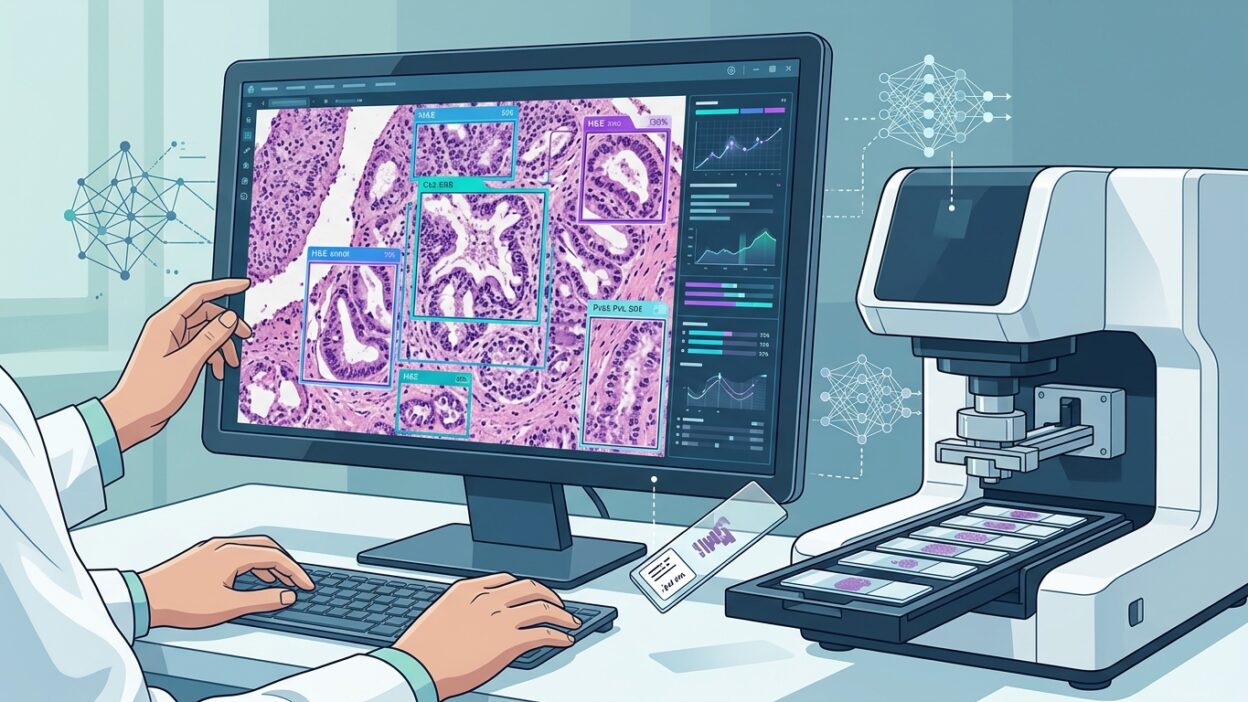
The publication of Validation, implementation, and impact of an AI model in routine practice for pathologic diagnosis of prostate cancer in an academic medical center brings back a practical question that matters to pathologists more than any marketing claim about artificial intelligence: what happens when a model leaves the demo stage and enters the daily diagnostic room?
The study was published in the Journal of Pathology Informatics in 2026 and is attributed to Agnes I. Udoh, Eduardo Eyzaguirre, Vidarshi Muthukumarana, and Harshwardhan M. Thaker from the University of Texas Medical Branch. The title matters because it puts three words together that are often separated in discussion: validation, implementation, and impact. Many prostate cancer models are presented with good performance numbers on selected slide sets. The harder part starts afterward, when they are introduced into real work, with variation in section quality, staining, scanning, time pressure, and the case mix from one day to the next.
Why prostate cancer deserves this kind of testing
Prostate needle biopsies are a suitable setting for testing physician-assistive models, but they are not an easy setting. The workload is large, small low-grade foci can be tiring during repeated review, and separating benign from malignant glands or distinguishing different patterns requires steady attention. At the same time, the model cannot be treated as an independent reader. The diagnostic decision remains the pathologist’s responsibility, and the model does not have the physician’s context or the experience needed to connect the slide with the clinical request and the other specimens.
That is why the value of this paper lies in its focus on use inside an academic center, rather than on an isolated external test. An academic center includes trainees, subspecialists, referral cases, differences in preparation, and internal discussions about grading. If the model is not tested within those details, the team may get an attractive result on paper and then meet a workflow that cannot tolerate extra windows, alerts, or steps that do not change the decision.
Local validation is not a formality
The main lesson here is that local validation is not an administrative stamp of approval. A model trained on images from other institutions can be affected by details that seem small: scanner type, color settings, section thickness, how tissue is placed on the slide, and the kinds of cases reaching the department. Even if overall performance is acceptable, the department needs to know where the errors occur. Does the model miss small foci? Does it overcall areas of inflammation or atrophy? Does it behave differently with folds, hemorrhage, or uneven staining?
These questions cannot be answered by a single number such as sensitivity or specificity. The pathologist needs visual examples, review of discordant cases, and links between errors and their histologic context. At that point, validation becomes an educational exercise for the whole department. It is not enough for the team to know that the model works. They need to know when it fails, what the failure looks like on screen, and which cases should not give the model much weight.
The true impact appears in the pathologist’s behavior
The word “impact” in the study title needs careful reading. Impact in pathology practice does not necessarily mean that the model found a cancer that would certainly have been missed, and it does not mean reading time fell in every case. The more important impact may be quieter: directing attention, reducing the need to go back repeatedly through some slides, speeding access to a suspicious focus, or adding another review layer in cases with a high cognitive load.
In prostate cancer, specifically, the most rational use may be to support reading rather than replace it. The model can point to areas that need a second look, but it does not decide the relationship between the histologic pattern and the final report. Grading, estimated tumor extent, the presence of perineural invasion, and concordance across cores remain part of the pathologist’s reading. Any system that ignores this will add noise instead of reducing it.
What the department should ask before adoption
The first question is where the model’s results appear inside the work screen. If the result requires moving to a separate platform, use will probably decline after the initial enthusiasm. If alerts interrupt reading, the system can become a burden. The better option is to deliver the information where the pathologist is already working, with a clear ability to open and close marks without disrupting conventional review.
The second question is how benefit will be measured after launch. Announcing a go-live date is not enough. The department should track defined measures: the rate at which pathologists reviewed model marks, the types of disagreements, reading time in negative and dense cases, the system’s effect on trainees, and the number of cases that needed extra discussion because of the model output. These data are not just for administrative reporting. They show whether the system is serving diagnosis or adding another layer of work.
The third question is responsibility. When the model gives a wrong signal or no signal, who reviews the pattern? How are incidents documented? Is there a mechanism to stop use if drift appears after a scanner or staining change? These questions sound technical, but they are really questions of quality and diagnostic safety. A department that does not address them early will have to answer them under the pressure of a problematic case.
Practical value does not come from promotion
Discussion of AI in pathology often slides into one of two positions: broad optimism or complete rejection. A study like this moves the conversation into a more precise area. The model may be useful if it is placed at a defined point in the workflow, after good local validation, with continued monitoring of its effect. It may have limited value if it is added on top of an already overloaded system without rearranging how cases are displayed, reviewed, and documented.
For the pathologist, evaluation starts at a specific point: where does the model change a decision during prostate biopsy interpretation, save effort, or reduce risk? If we cannot identify that point clearly, we may need a better test before buying the system or expanding its use.
A professional reading of the news
Pathology News selecting this research reflects a shift from performance papers to papers about putting systems into service. That shift matters for departments thinking about WSI, IMS, and diagnostic assistance models as one package. The success of any model is tied to scanning, case management, system speed, user training, and quality policy.
The message I take from this news is simple: do not judge the model by its marketing image. Judge it by its effect on a real report, during a busy workday, with an imperfect specimen. Only there does the difference appear between a tool that helps the pathologist and a tool that consumes attention.
Source: Pathology News. DOI: 10.1016/j.jpi.2026.100675.