

A deal that goes beyond an acquisition headline
Roche has signed a definitive agreement to acquire PathAI, the US company known for digital pathology and image-analysis algorithms used by laboratories and pharmaceutical companies. The announced deal includes $750 million upfront, with milestone payments of up to $300 million. The transaction is expected to close in the second half of the year. After regulatory clearance, PathAI will become part of Roche Diagnostics.
For pathologists, this is not only a change in ownership for a technology company. The more important issue is PathAI’s position inside a company with a large presence in companion diagnostics, laboratory instruments, and digital pathology platforms. When WSI algorithms move from an independent company into a commercial and regulatory structure of this size, the professional question becomes more specific: how will laboratory workflow change, and who defines the standards for validation, monitoring, and responsibility?
PathAI is not a marginal name in this field. The company developed the AISight IMS platform for image management and analysis, worked with Roche since 2021, and expanded the collaboration in 2024 to include algorithms linked to companion diagnostics. That sequence matters. This deal did not come out of nowhere. It follows a period in which a global diagnostics company and an AI company specialized in pathology tested the relationship in practice.
Why does this matter to pathologists?
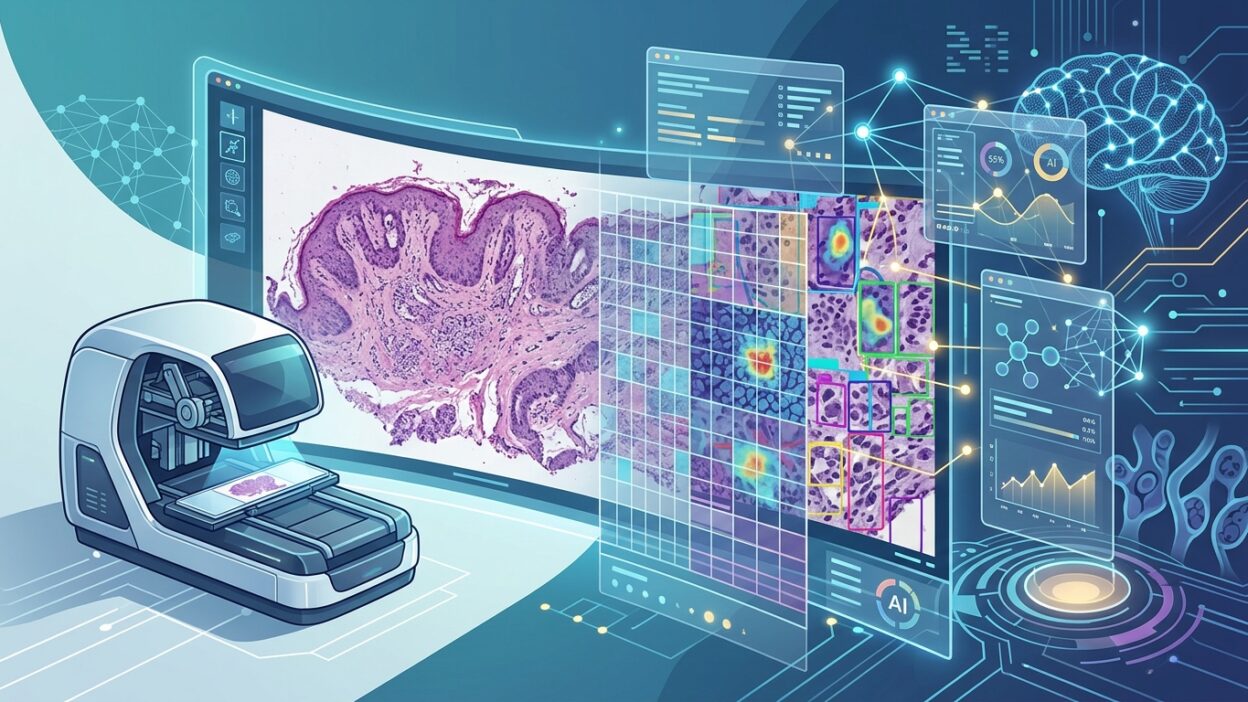
A superficial reading is that Roche bought an AI company. A professional reading is that the diagnostic chain itself may be rearranged. In a traditional laboratory, the scanner produces the image, the image management system stores and displays it, the algorithm analyzes one part of it, and the report often sits in a separate system. That fragmentation has slowed the adoption of AI in daily practice, even when models perform well in research testing.
If Roche succeeds in integrating AISight IMS with its digital and diagnostic portfolio, laboratories may see a less scattered pathway: a digital image, image analysis, IHC or H&E interpretation, connection to a companion diagnostic, and then a reviewable result within one workflow. This does not remove the physician’s role. It raises the level of questions a pathologist must ask before accepting any new tool.
The question is no longer: is the algorithm accurate? That is incomplete. The better question is: accurate on which tissue, which stain, which scanner, which fixation protocol, and which software version? How does it behave when slide quality varies or when there is an obvious artifact? Then comes the next layer: who reviews failure cases, and who stops the model when performance drift appears?
Companion diagnostics sit at the center of the deal
Roche has a strong position in companion diagnostics, which makes the deal more sensitive for daily pathology practice in oncology. An algorithm that measures a tissue biomarker or predicts therapeutic response does not exist apart from the drug pathway. It enters patient selection, trial design, result interpretation, and in some cases direct clinical decision-making.
This is where PathAI has value for Roche. The company does not only provide an IMS interface. It also has experience supporting clinical trials, translational research, and biomarker discovery from histology images. If that work is combined with Roche’s companion diagnostics experience, some algorithms may move from research analysis toward tools closer to clinical validation, particularly in tumors that require careful patient stratification.
But that point carries serious responsibility. A WSI-derived biomarker must prove its validity on diverse specimens, not only on a selected training set. It also has to be interpretable enough for a pathologist to know when to trust it and when to stop and question it. A probability score in a polished interface is not enough. The tool needs a clear effect on the decision, with known limits.
Pathology laboratories: benefit and vendor dependence
The potential benefit for laboratories is clear: less movement between systems, faster case triage, more consistent measurements, and a tighter link between image analysis and the wider diagnostic pathway. In high-volume laboratories, that difference may be tangible, especially in quantitative IHC, quality review, and identifying cases that need earlier attention.
Deep integration has a cost. The more closely the algorithm is tied to the scanner, IMS, assay, and workflow, the harder it becomes to change vendors later. A laboratory may find itself inside an integrated package that is difficult to separate, even if a better tool appears in one part of the chain. This is not an argument against the deal. It is a call to read contracts and operating standards with a clinical eye, not only a technical one.
Pathologists need practical answers before adoption. Can data and reports be exported easily? Does the system support DICOM pathology in a mature way? How is the model version used in each case preserved? Can the decision be audited months later? What happens when the algorithm is updated? Can the laboratory run tools from another vendor inside the same platform?
Governance matters more than the user interface
The press release mentions the efficiency and usability of AISight IMS. That matters, but it is not the deciding point. In clinical work, governance is the real test: version control, performance documentation, drift monitoring, data protection, and responsibility when the algorithmic result conflicts with the physician’s assessment.
Any laboratory planning to introduce AI into the diagnostic pathway should build an operational committee that includes pathology, information technology, quality, cybersecurity, and clinical management. The committee’s role is not limited to buying the system. It must define appropriate use cases, tool limits, how medical disagreement is recorded, and when use should be stopped if recurrent problems appear.
These details may sound less attractive than talking about artificial intelligence, but they determine whether implementation works. Many models look convincing in demonstrations and conferences. Fewer survive the pressure of daily workload, variation in tissue preparation, and accreditation expectations inside a laboratory serving real patients.
What should be watched after the deal closes?
The first point to watch is how AISight IMS is integrated with Roche’s current platforms. Will PathAI remain a relatively open platform, or will it move toward a tighter link with Roche’s portfolio? The answer will affect laboratories that already own scanners or image management systems from different vendors.
The second point is the path of algorithms linked to companion diagnostics. If Roche begins offering AI tools within packages connected to specific drugs or assays, laboratories will need clearly published performance data: specimen numbers, site diversity, scanner types, exclusion criteria, and inter-laboratory performance comparisons. A general accuracy claim is not enough.
The third point concerns the physician’s role in the final report. The system should remain designed around the pathologist’s decision, not around an automated output that is hard to challenge. The best use of AI in the laboratory is the one that makes the decision more auditable, not more opaque.
Professional bottom line
Roche’s acquisition of PathAI is important because its value is not measured only by the deal price. Its value lies in the possibility of moving AI from the edges of the workflow into the workflow itself, next to companion diagnostics and clinical drug development. That may help laboratories looking for tools that can run in daily practice, but it also forces difficult questions about validation, transparency, and limits on future choice.
Pathologists do not need to reject this wave, and they do not need to accept it with commercial enthusiasm. A professional position is simpler: ask for local performance data, review governance, preserve auditability, and make sure tissue-based decisions remain responsible and understandable. The deal will help laboratories only if it improves clinical work without making the physician dependent on a black box inside a closed platform.