

PathAI and A.C.Camargo in Brazil: what matters for pathologists?
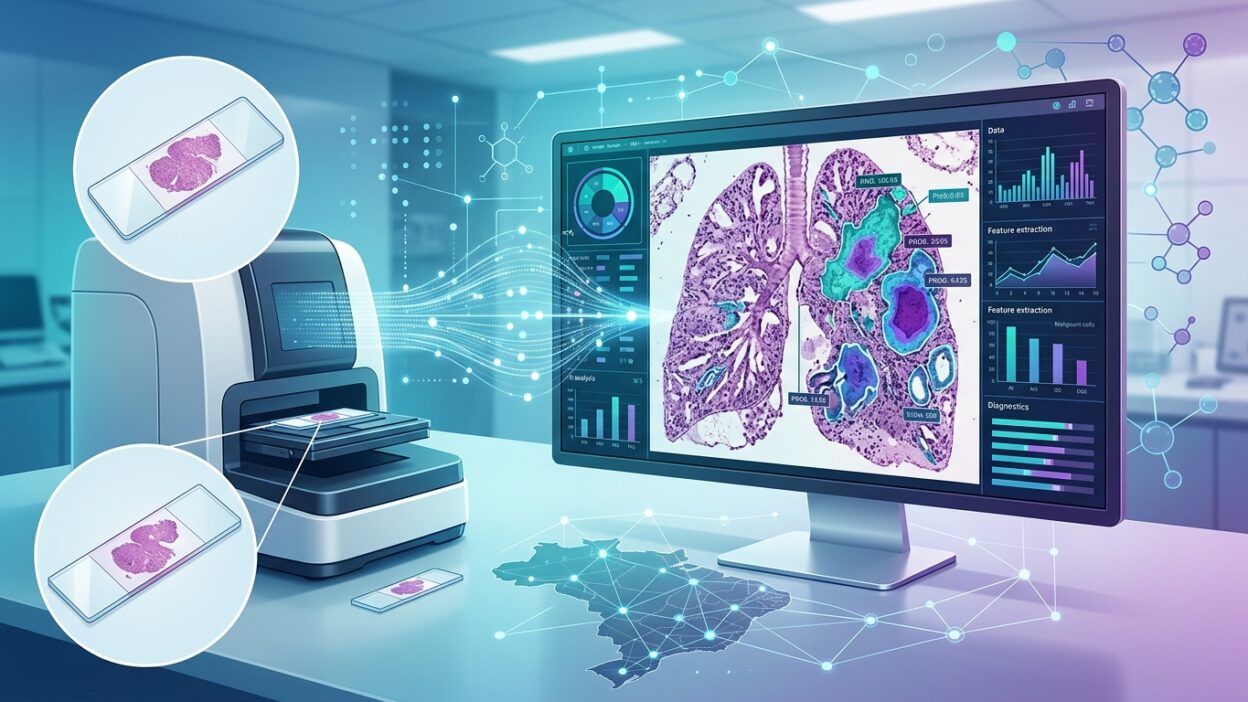
PathAI and A.C.Camargo Cancer Center announced a collaboration to support adoption of digital pathology and artificial intelligence tools in Brazil through SUS. At first glance, the news may look like a routine institutional announcement between a technology company and a major oncology center. For pathologists, it raises a practical question closer to daily work: how can AI move from demonstrations into a diagnostic workflow that serves real patients inside a public health system?
A.C.Camargo is not a small laboratory testing a new scanner at the edge of routine work. It is a cancer center with weight in treatment, education, and research. SUS is not a narrow private market. It is a public health system that serves a large share of the population. That is why the setting matters. This is not about a polished dashboard or a model published in a paper, but about trying to connect digital pathology with better access to oncology diagnosis across a broad health network.
Why does this matter beyond Brazil?
Many pathology departments in our region know the same problem under different names. Subspecialty expertise is concentrated in certain cities or centers, while specimens arrive from peripheral hospitals late and sometimes with incomplete data. The patient does not see these details, but pays for them through delayed reports, blocks being sent again, or waiting for review by a specific tissue oncology specialist.
Digital pathology can help here if it is used in the right place. Scanning alone does not solve the problem. Uploading a WSI to a platform does not mean diagnosis has become faster or more accurate. Improvement starts when the workflow changes: who receives the case? Who checks image quality? How are urgent cases triaged? When are additional stains requested? And how does the subspecialty opinion reach the treating physician without long administrative loops?
These are the questions that make the PathAI and A.C.Camargo collaboration important for physicians, not the marketing headline around AI. Success will not be measured only by the number of scanned slides. It will be measured by effects on turnaround time, consistency of interpretation, fewer delayed referrals, and protection of the pathologist’s responsibility when AI is used inside the workflow.
AI inside the diagnostic workflow, not above it
The biggest mistake in reading pathology AI news is treating the algorithm as an independent replacement. In daily practice, most value will not come from a final automated decision. It will come from defined tasks: triaging cases, drawing attention to suspicious areas, supporting quantification for selected markers, or ordering the worklist by likelihood that a case needs faster review.
That changes expectations. The pathologist does not need a tool that claims to see everything. The pathologist needs a tool that knows its limits, shows why it made a suggestion, and fits into the laboratory system without creating extra work. Any system that increases clicks, forces movement between too many screens, or delays final sign-out will meet reasonable resistance even if its research results are good.
In an environment such as SUS, this point becomes more sensitive. Case volume is high, and differences between laboratories may be clear in preparation, scanning, network connectivity, and data integration. Any broad implementation therefore needs clear protocols before performance is discussed: pre-scan requirements, image acceptance criteria, handling of unusable slides, and a training plan for technologists and physicians.
Governance matters more than fascination
It is not enough for the tool to be accurate in a test set. The department has to know where it enters the workflow, who has the right to ignore it, and when its outputs should be documented. If the algorithm suggests a suspicious area and the physician disagrees, is that recorded? If a technical fault affects a batch of slides, who stops the workflow? If the model version changes after a software update, is internal validation repeated?
These are not minor administrative questions. They are part of pathology practice. Final sign-out remains a medical responsibility, and any tool that enters before the report should be governed with the same logic we apply to stains, instruments, and quality control. The difference is that AI adds a less visible layer of probabilities, and its performance may change with tissue type, preparation, scanner, or population characteristics.
For that reason, the project will need monitoring indicators that physicians understand, not only technical metrics. Examples include mean turnaround time before and after implementation, the proportion of cases redirected to a subspecialist, the number of slides rejected because of scan quality, the effect of the tool on requests for additional IHC, and agreement between the output and the physician’s decision in defined scenarios.
What can we learn?
The first lesson is that digital pathology does not succeed as a device purchase alone. It requires redesigning the specimen pathway from arrival in the laboratory to delivery of the report to the treating team. If the workflow does not change, scanning becomes another layer of work instead of reducing delay.
The second lesson is that reference oncology centers can play a different role. Instead of receiving every specimen physically, they can support a wider network through digital review, education, and standards. This does not remove the need for strong local infrastructure, but it allows expertise to be distributed more fairly, especially for rare or complex cases.
The third lesson is that pathologist acceptance is not a later detail. Physicians will accept the tool when it respects their work: reviewable results, an interface that does not interrupt reading, integration with the LIS, and a clear policy for sign-out and responsibility. If the tool is presented as a new production pressure or a disguised replacement, it will fail where it matters: at the reporting desk.
Practical takeaway
The PathAI and A.C.Camargo collaboration through SUS deserves follow-up because it tests a hard question: can digital pathology and AI expand access to high-quality diagnostic expertise inside a public health system? The answer will not come from one press release. It will appear in report turnaround time, scan quality, physician acceptance, governance clarity, and the ability of patients outside major centers to receive a subspecialty opinion without long delay.
For the pathologist, this is the more important angle. We should not be distracted by the theoretical question of replacing the physician. The closer professional question is this: will this workflow make our decisions faster, better documented, and easier to review? If the answer is yes, the technology has a place in the laboratory. If the answer is unclear, the fault is usually in the design, not in the idea of digitization itself.