

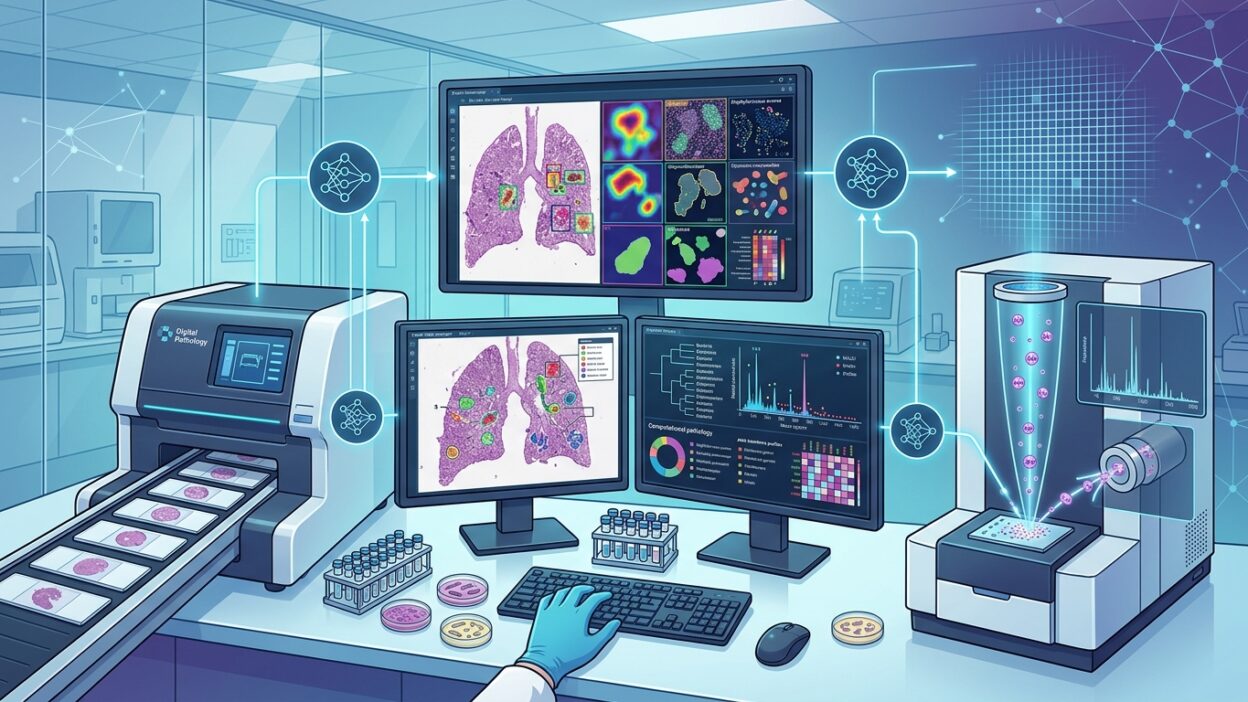
ESCMID Global 2026 raised a practical question that laboratories cannot ignore: what happens when the result becomes faster than the clinical system’s ability to use it? The article in The Pathologist captures this tension clearly, especially in clinical microbiology, where diagnostic technologies are racing against the pressures of sepsis, antimicrobial resistance, and limited resources.
This is not only about speed. In the laboratory, turnaround time matters, but it does not tell the whole story. A rapid result may shorten the time to starting or changing treatment. It may also become extra noise if it is not tied to clinical context, a reporting system that defines who receives the result and when, and a clear antimicrobial policy.
Speed needs a quality gatekeeper
The article quoted Heiman Wertheim making a direct point: we need faster tests, but not at the expense of quality. That sounds obvious inside the laboratory, yet it can clash with administrative or clinical enthusiasm for reducing turnaround time at any cost. A test that gives an answer within minutes is not useful just because it is fast. It has to prove its performance on the specimens that actually reach the laboratory, not on ideal specimens in a marketing file or a limited study.
In neonatal sepsis, for example, the challenge is not simply choosing a faster platform. The sample volume is small, the bacterial load may be low, and the treatment decision cannot wait. Any new test has to face these details from the start: limit of detection, the effect of prior antibiotic exposure on the result, the rate of inconclusive results, and how to handle a positive result that does not fit the clinical picture.
For antimicrobial resistance, success is defined more narrowly. Identifying the pathogen is one step. What the clinician often needs is usable susceptibility information before the window for changing treatment loses its value. This is where the difference appears between a test that saves time on paper and a test that actually changes the antibiotic prescription.
Many technologies, one laboratory question
Conference sessions reviewed several directions: nanoplasmonic colorimetry, systems based on nanomotion, Raman micro-spectroscopy, and artificial intelligence applications in classification and detection, while MALDI-TOF continues to expand its role in bloodstream infections and antimicrobial resistance detection. Metagenomics was also present as an option that broadens detection and reduces reliance on culture in some scenarios.
For pathologists, this variety does not mean that every platform suits every laboratory. The more important question when evaluating any technology is: where will it enter the workflow? Before culture or after it? As a screening test or a confirmatory test? Will the result be issued in a form that can guide clinical action, or will it add a long list of possibilities that require manual interpretation?
Artificial intelligence deserves the same treatment. In microbiology, models can help read images, classify patterns, or support detection of specific resistance mechanisms. But a model does not exempt the laboratory from local validation. Specimen type, preparation, instrument, and the hospital’s isolate distribution can all change performance. It is not enough for a model to look convincing in a published paper. It has to hold up against the laboratory’s own data.
A rapid report has little value if it reaches a dead end
One important point in the article is that a rapid test may simply move the bottleneck somewhere else. If an early result is issued outside the working hours of the team able to adjust treatment, nothing changes. If the result reaches the physician without an appropriate comment or a clear communication channel, misunderstanding becomes more likely. If the antimicrobial policy does not define what to do after a specific resistance mechanism appears, speed will not rescue the decision.
Adopting rapid tests therefore requires prior agreement between the laboratory, infectious diseases, clinical pharmacy, intensive care, and quality teams. Not a formal meeting for appearances. Specific intervention points have to be defined: when does the laboratory call? Who has authority to change treatment? What text appears in the report? Which cases need additional confirmation? And how will the outcome be measured after implementation?
Measurement here should go beyond turnaround time. More important indicators include time to antibiotic adjustment, length of stay in intensive care for the relevant patient groups, the proportion of unnecessary therapies stopped, the rate of repeat cultures or follow-up tests, and the proportion of results that required extra interpretation because the report was unclear.
Regulation and validation are not secondary obstacles
The article also referred to discussion about digital models and simulation in regulatory and evaluation files. This direction may help test complex tools, especially when they combine molecular data, algorithms, and multilayered interpretation. But it does not remove the laboratory’s daily rules: validation before launch, performance monitoring after launch, and periodic review when reagents, instruments, or organism distribution change.
The problem is that some technologies enter the market with language that promises a lot, while the laboratory needs details that are less glossy and more solid: which specimen types failed? What is the limit of detection in low-volume blood samples? How does the system behave with mixed infection? What is the effect of contamination? What proportion of results cannot be reported? These questions may sound tedious, but they protect the patient and the laboratory’s credibility.
What should pathologists do now?
The first step is to reject evaluation of a rapid test in isolation from the clinical decision. Any purchase request or technology implementation project should start with a defined scenario: a patient with suspected bloodstream infection, a newborn infant, an isolate with possible resistance, or a case where broad-spectrum treatment may need to be stopped. Only then does it make sense to ask which platform is appropriate.
The second step is to design validation using local specimens. It is not enough to copy sensitivity and specificity figures from an external study, especially in AMR, where the prevalence of mechanisms differs between hospitals. Validation should include easy and difficult specimens, expected failure cases, and a clear comparison with the reference method or the laboratory’s approved pathway.
The third step is to write the report as a decision tool, not as a technical output. A good report explains what the result means and what it does not mean, states when later confirmation is needed, and avoids broad wording that leaves the physician with an open-ended interpretation. In rapid testing, report wording is part of the test itself.
The main message from ESCMID Global 2026 is that the laboratory will not win the diagnostic race by buying a faster instrument alone. It will win when it connects speed with quality, local validation, and a treatment pathway that knows how to use the result. That is the difference between an early result and a better decision.
Source: The Pathologist