

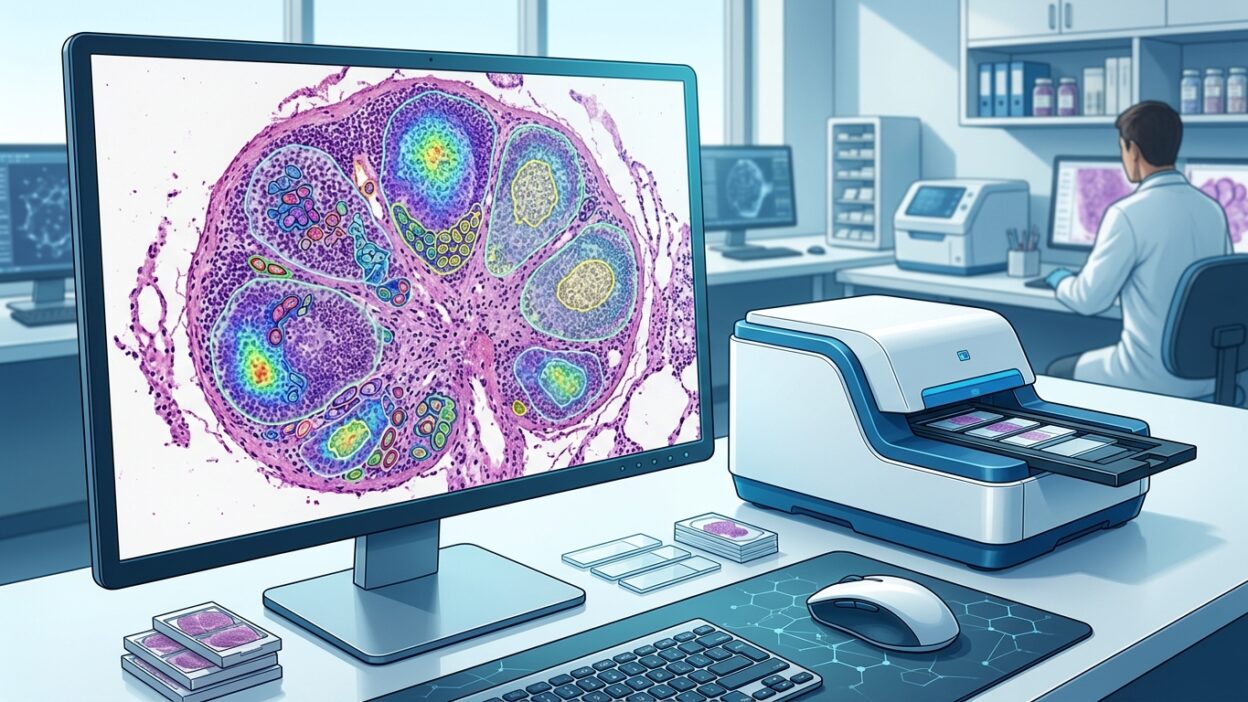
A team from Hong Kong University of Science and Technology introduced a system called PRET, short for Pan-cancer Recognition without Example Training, with results published in Nature Cancer. The news is not simply another model adding a new number to an AUC table. What matters for pathologists is how the model is used: a new task, a small number of annotated slides, and no need for cancer-specific or task-specific fine-tuning.
The idea comes from in-context learning in language models, but it has been moved into WSI analysis. Instead of training a separate model or adapting a foundation model on thousands of images, PRET uses between one and eight annotated slides as references during inference. It then performs tasks such as cancer screening, tumor subtyping, and tumor segmentation within one framework.
That detail matters in practice. Many pathology AI models look strong in development datasets, then the hard questions start when they move to another laboratory: a different scanner, different staining, a different case mix, and a patient population that does not match the training set. If the model needs a new training cycle for every task, the operational burden starts to resemble the development burden. PRET tries to break that loop by reducing dependence on large datasets and repeated training.
According to the report, the system was tested on 23 benchmark datasets from institutions in China, the United States, and the Netherlands. The experiments covered 18 cancer types and several diagnostic tasks. PRET outperformed previous methods in 20 tasks and exceeded an AUC of 97% in 15 tasks. Those are strong numbers, but they are still benchmark numbers. Their value becomes clearer when they are read alongside the model design and the number of examples required.
The clearest result for pathologists came in lymph node metastasis detection. Using only eight slides as examples, PRET reached an AUC of about 98.71%. In the same comparison, the average performance of 11 pathologists was close to an AUC of 81%. This should not be turned into a simplified headline saying the model is “better than pathologists” at everything. The task is specific, the comparison has its conditions, and AUC does not summarize everything that happens in daily sign-out. But the number is hard to ignore.
More interesting than superiority in one task is the claim of generalization across cancers and centers. If one model can handle screening, subtyping, and segmentation through a few examples, it starts to look more like an adaptive tool inside the laboratory rather than a closed classifier. That distinction is important for settings without internal machine learning teams, or without the capacity to build large datasets for every diagnostic question.
Still, the path to clinical use does not start and end with an AUC. A laboratory needs to know how the model performs on borderline cases, artifacts, and differences in fixation, section thickness, and staining. It also needs to see performance when sample quality drops, when mixed patterns are present, and when cases do not resemble the eight examples supplied to the model. These are not minor details. They are where the difference is decided between a model that works in a paper and a system that can be trusted in a real workflow.
There is another question for the pathologist: how will the result be shown? If PRET is used for lymph node metastasis detection, for example, does it provide a reviewable heatmap? Does it identify suspicious regions in a way that helps examination, or does it add another layer of unnecessary alerts? And can it maintain high sensitivity without raising false positives to a level that slows the work? These questions determine practical value more than the name of the technique.
The positive side of PRET is that it moves the discussion toward a real problem in digital pathology: how to build AI that does not need to be rebuilt for every new use. In laboratories with limited resources, this may be the difference between a system that can be tested and a system that remains out of reach. In large centers, it may shorten the path from research model to internal validation.
The bottom line is that PRET should not be read as a replacement for the pathologist, or as final proof that in-context learning is ready for sign-out. A more accurate reading is that the model compresses one of the largest costs in pathology AI: annotated data and repeated training. If this direction holds in external cohorts and under conditions close to daily laboratory work, in-context learning may become one practical route for making AI pathology less dependent on retraining and more able to adapt.
Source: Pathology News