

Where the story began
In an interview in the Thought Leaders series on Pathology News, Professor Liron Pantanowitz, chair of pathology at the University of Pittsburgh, discusses his path from pathology informatics to leading one of the largest digital transformation projects in the field.
Pantanowitz had first-hand experience with manual laboratory workflows and their operational friction. That early frustration pushed him to look for digital alternatives when many colleagues were still comfortable with glass microscopy.
UPMC and scaling up
UPMC includes many hospitals, and Pantanowitz explains how slides are digitized across this large network. The real turning point was not simply buying scanners. It was building the software infrastructure that made images accessible from any point in the network.
Pantanowitz points to the CPACE AI Center, which brings together imaging data, text, and tabular data. The platform feeds multiple models with different types of clinical data rather than relying on a single model.
Two types of AI in the laboratory
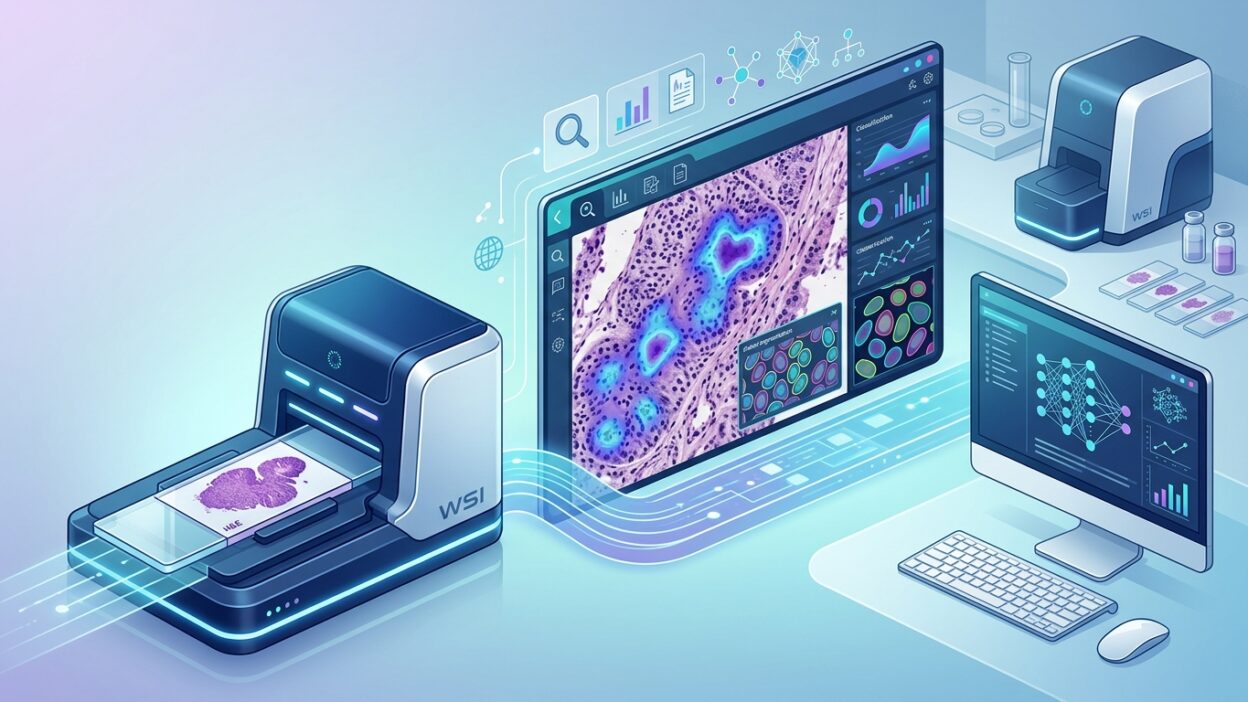
Pantanowitz distinguishes between two models: traditional image-based diagnostic models, such as pattern detection, cell proportion calculations, and identification of regions of interest, and generative AI entering clinical workflows through report processing and data summarization. Each works in a different context. Laboratories that understand this distinction will adopt faster.
The real barriers
Pantanowitz identifies three barriers: interoperability between systems, integration of products from several vendors, and cultural resistance among pathologists.
The main cultural barrier is that many pathologists suspect digitization will slow them down. Practical experience shows the opposite. But convincing colleagues requires evidence from day-to-day practice, not research papers alone.
Another problem is the lack of reimbursement models. There is no clear billing mechanism for AI applications in histopathologic diagnosis. Without reimbursement, laboratories struggle to justify the investment.
The Scan Van initiative
Pantanowitz mentions the Scan Van concept: a mobile vehicle equipped with scanners to digitize slides at sites without digital infrastructure. The idea is simple: if you cannot bring the slides to the scanner, bring the scanner to the slides.
Sometimes the challenge is logistical, not technical. The question is how the technology reaches small laboratories and remote sites.
The digital archive
Building a digital slide archive is a strategic need, not a luxury. Laboratories with organized digital archives will be better positioned to train AI models, provide remote consultation services, and meet future regulatory requirements. Laboratories that do not start digitizing now will find it harder to catch up.
What this means for pathologists
If you work in a laboratory that still depends entirely on glass microscopy, the question is when you will move to digital, not whether you will. UPMC’s experience shows that the transition is possible even in large, complex networks.
Start with archiving. Look for interoperability before committing to a single platform. And do not wait for the perfect reimbursement model. Infrastructure takes time to build.