

Study background
Endoscopic surveillance for Barrett esophagus is an established clinical practice, but it has a real limitation: about 10% of dysplasia and cancer cases are missed. The problem is not the principle of surveillance, but its delivery. As Professor Rebecca Fitzgerald from the University of Cambridge explained, many of these endoscopies are performed by non-specialists, which means some patients return within a year with an interval malignancy that should have been diagnosed earlier.
At the same time, the progression rate from non-dysplastic Barrett esophagus to adenocarcinoma is low. Repeated endoscopic surveillance is expensive for health systems and burdensome for patients. Some health systems have already started to stop surveillance for low-risk patients, but that approach carries the risk of missing rare but serious cases.
What is the capsule sponge?
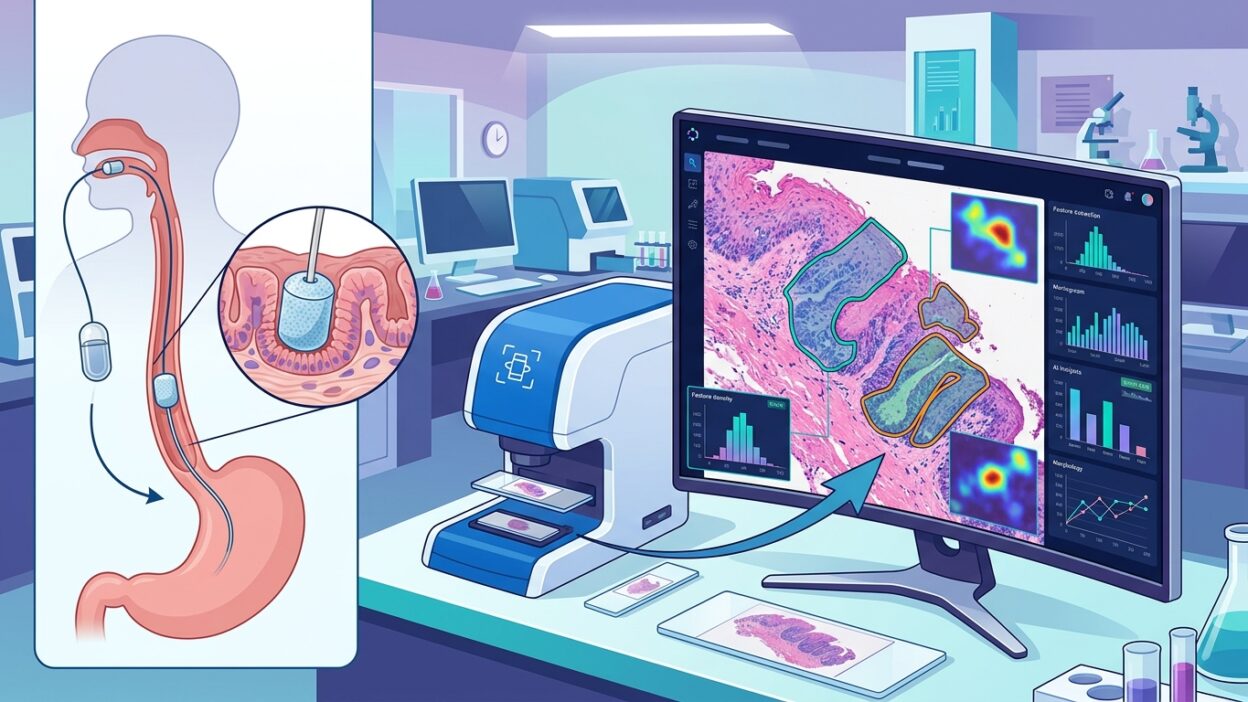
The test is simple in principle: the patient swallows a capsule attached to a string, containing a compressed sponge. When the capsule dissolves in the stomach, the sponge expands and is pulled back through the esophagus, collecting cells from the esophageal lining along its path. No sedation is needed. No operating room is needed. The test is done in the outpatient clinic within minutes.
The collected sample is then analyzed using a panel of biomarkers, including TFF3 and other markers that help identify intestinal metaplasia and assess risk. The idea is not to replace endoscopy completely, but to stratify patients so that each patient receives surveillance that matches their actual risk.
Study results
The UK study, published in The Lancet, included 910 patients in a real-world clinical implementation setting, not a tightly controlled trial. That matters: trial results do not always translate into daily practice.
The main result was that the test safely identified more than half of patients with Barrett esophagus who could avoid periodic endoscopic surveillance and instead be followed with this less invasive test. More importantly, it identified an ultra-high-risk group with an 85% likelihood of dysplasia or cancer.
That 85% figure is not a theoretical number. It means that patients with strongly positive test results need prompt intervention and detailed diagnostic endoscopy, while patients with low-risk results can avoid repeated endoscopies without unnecessary anxiety.
Why this matters for pathologists
The pathologist is central to this model. A capsule sponge sample needs histologic assessment and biomarker testing, which sits directly within the work of pathology laboratories. Smaller samples do not necessarily mean less laboratory work. In practice, they may mean a different pattern of work: more samples, but simpler samples, with greater emphasis on immunohistochemical and molecular assessment rather than conventional histologic assessment of endoscopic biopsies.
The practical challenge is that laboratories need protocols for assessing these samples, criteria for interpretation, and staff training for the new workflow. The biomarkers used in the test require familiar immunohistochemical and molecular assays, but these assays need standardization in the specific context of capsule sponge testing.
Impact on care pathways
The numbers are clear. If more than 50% of patients with Barrett esophagus can be classified as low risk by this test, the burden on endoscopy units can be reduced in a meaningful way. Instead of repeated endoscopies every two to three years for every patient with Barrett esophagus, endoscopy can be focused on groups with genuine risk.
The harder question is how much confidence can be placed in a negative result. The study indicates that the test is safe for patient stratification, but translation into different health care settings needs validation. The incidence of adenocarcinoma in Barrett esophagus varies across populations and geographic regions.
Limitations to consider
The study was conducted in the United Kingdom within a specific health system. Applying the findings to other health systems, especially in countries with limited resources or different Barrett esophagus surveillance practices, will require additional studies.
The test also complements endoscopy; it does not replace it. Patients with positive results need detailed diagnostic endoscopy with multiple biopsies for confirmation and classification. The main benefit is reducing routine endoscopies for patients who do not actually need them.
Conclusion
The capsule sponge test with biomarkers provides strong evidence that Barrett esophagus surveillance can be simplified. The key figure is 85%: the likelihood of dysplasia or cancer in the high-risk group identified by the test. This is not a replacement for endoscopy, but a triage tool that may change how resources are allocated in Barrett esophagus surveillance.
For pathology departments, this is part of a recurring shift: less invasive tests that depend more on biomarkers and molecular analysis. Preparing for that shift early is better than trying to catch up later.
Source: Fitzgerald RC et al. The Lancet, 2025. DOI: 10.1016/S0140-6736(25)01021-9
Link: Original article in The Lancet
News report: Pathology News