

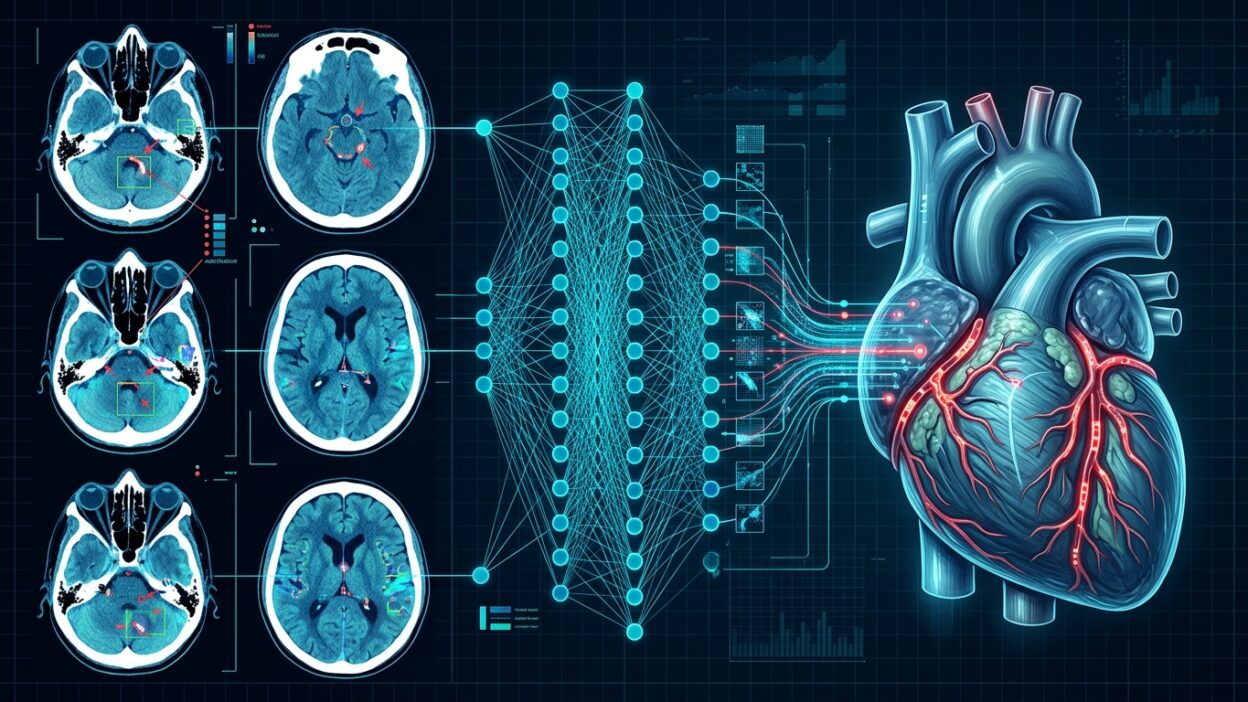
Brain CT predicts cardiovascular disease: Stanford JACC study finds hidden risk signals in routine emergency imaging
The study in one number
A new Stanford study published in JACC showed that routine head CT in the emergency department carries predictive information about cardiovascular risk that can outperform established clinical models. The study included about 28,000 patients.
Main findings
An AI model analyzed routine head CTs and extracted hidden cardiovascular information. The results:
It outperformed the AHA PREVENT clinical score by a clear margin: C-index 0.82 versus 0.75. The model identified younger patients with an apparently clean risk profile who still had Silent Brain Infarcts and Intracranial Calcifications that traditional risk factors do not capture.
15.7% of patients were reclassified between risk groups, and 74.5% of those reclassifications were correct. The model also estimated Coronary Artery Calcium Scores from Head CTs, improving the identification of patients with CAC above 100.
Context: 22.5 million scans each year
In the United States alone, 22.5 million Head CTs are performed each year. Most are read for one question: acute hemorrhage or stroke. After that, the scan is archived and rarely revisited.
What if each of these scans automatically produced a cardiovascular risk assessment? No extra scan. No extra cost. No extra radiation.
Why this matters for pathologists
This Opportunistic Screening method applies directly to digital pathology. The same principle is at work: extracting extra information from tests that are already being performed.
In pathology, you read slides for a specific diagnostic purpose. AI can extract additional predictive information from the same slide: molecular biomarkers, recurrence probability, and expected treatment response.
The study shows that Imaging Biomarkers present in routine but underused examinations carry measurable clinical value. This is exactly what companies such as Imagene AI, Paige, and others are trying to apply to WSI.
Technical method
The model studied about 28,000 Stanford patients. It extracted features from Head CTs, including Silent Brain Infarcts, Intracranial Calcifications, vascular changes, and other findings. These features are often absent from the clinical report because they are not the reason the scan was ordered.
A C-index of 0.82 means the model had high discriminatory ability for predicting future cardiovascular events: myocardial infarction, stroke, and heart failure.
Impact on emergency department practice
Many emergency department patients do not have a family physician or regular cardiology follow-up. A Head CT is performed anyway. Adding cardiovascular risk assessment as an automated secondary output creates a chance for earlier intervention in a large group of patients who would otherwise be missed.
Limitations
The study came from a single center, Stanford. It still needs external validation across multiple centers. A cost-benefit analysis for adding this Screening step to emergency department workflow has also not yet been published.
Bottom line
The study adds strong evidence that Opportunistic AI Screening is not a theoretical idea but a clinical workflow that can be measured with numbers. The same logic applies in digital pathology to WSI and other routine histology examinations. The information is already in the image. The question is whether we extract it or ignore it.