That persistent ache in your neck? Those stacks of glass slides threatening to topple from your desk? That nagging feeling there aren’t enough hours in the day? This is the silent tax you pay for the traditional microscope. And it’s a price you no longer have to pay.
For decades, the microscope has been the cornerstone of pathology. But in an era of instant access and smart technology, the microscope itself has become the bottleneck. We, as pathologists, are tethered to a physical location, shackled by a tool that is, frankly, starting to hinder our progress. The world has evolved, and it’s time our most critical tool evolved too.
The Hidden Scars of the Status Quo
Let’s be frank, the daily grind of traditional pathology can be physically taxing. Reports indicate that 62% of microscope users experience musculoskeletal issues, specifically in the neck and back. Even more striking, 94% suffer from some form of eye strain. We accept this as part of the job, but should we?
Beyond the physical toll, there’s inefficiency. The endless paper trails, the frantic search for archived slides, the logistical nightmare of shipping glass slides for a second opinion – it all adds up. In one large regional pathology lab, transitioning to digital saved over 19 hours of labor in a single day. Imagine what you could do with that extra time.
A Glimpse into the Digital Dawn
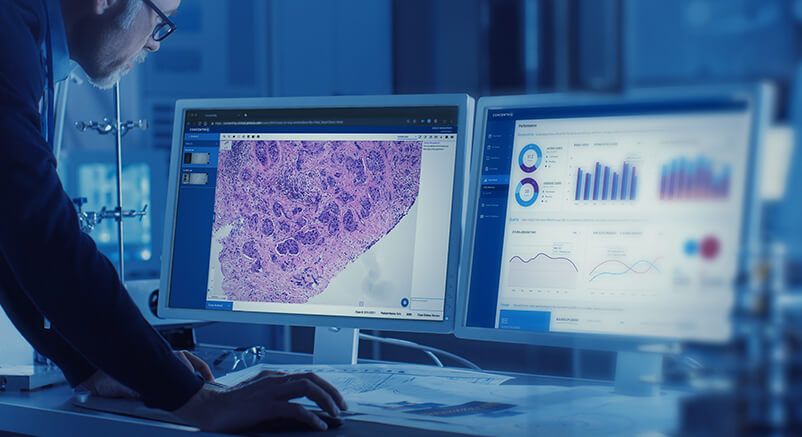
Now, picture this: You’re signing out cases from the comfort of your home office. You’re collaborating with a subspecialist in another country, in real-time, without ever touching a shipping label. A patient’s entire slide history is at your fingertips in seconds. This isn’t a distant dream; it’s the reality of digital pathology, and it’s happening now.
Take, for instance, a large academic center that went digital. They saw a massive 93% to 97% reduction in requests for physical glass slides. This shift didn’t just save storage space; it translated into an estimated annual savings of $114,000 in ancillary testing, and a projected $1.3 million savings over 5 years. Crucially, the turnaround time for surgical resection cases decreased by a full day.
Your New Partner: AI
And here’s the game-changer: AI. It’s not about replacing pathologists; it’s about augmenting our expertise. Think of it as the smartest, most tireless resident you’ve ever worked with. AI can handle tedious, repetitive tasks like cell counting, freeing you to focus on complex diagnoses.
The results are already impressive. In one study, AI reduced the average time a pathologist spent on a case by 25% when quantifying PD-L1 protein expression in non-small cell lung cancer. It’s not just about speed; it’s about accuracy too. AI can detect subtle patterns and anomalies that the human eye might miss, leading to more precise and consistent diagnoses.
The Tipping Point is Here
The transition to digital pathology is no longer a question of ‘if,’ but ‘when.’ For those of us who have made the leap, the benefits are undeniable. In one survey, 80% of pathologists agreed that whole slide images (WSI) improved their clinical sign-out experience. It goes beyond just technology; it’s about a better way to work and a better quality of life.
The learning curve is real, but the rewards are immeasurable: enhanced efficiency, improved diagnostic accuracy, and a work-life balance you might have thought impossible.
Don’t let the future of pathology pass you by. It’s time to step away from the microscope eyepiece and into the digital age. Your career, and your well-being, will thank you for it.
Ready to begin your digital pathology journey? Share this article with a colleague who needs to see it and start the conversation in your lab.