

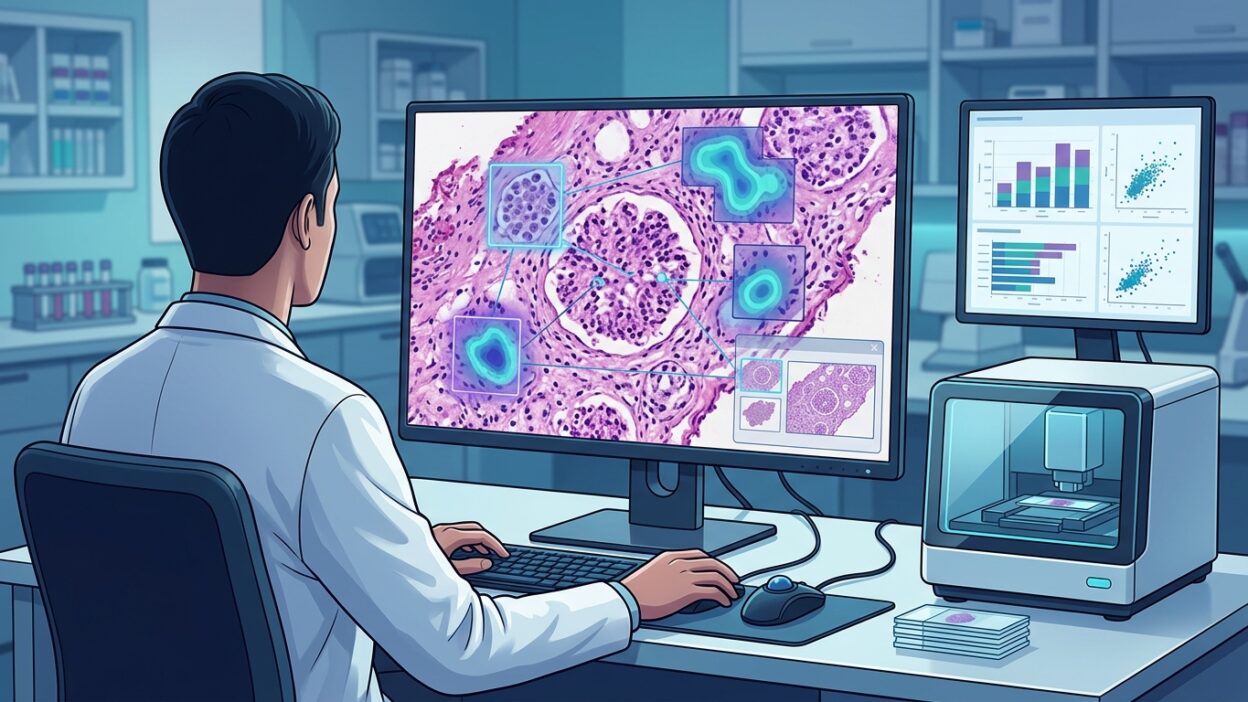
Start with a simple daily situation.
A pathologist opens a lymph node WSI and looks for a tiny metastasis. The pathologist does not read the slide like a normal image. They start with the overview, move to suspicious areas, zoom in, step back, and compare the cells with the surrounding tissue pattern. Sometimes the diagnosis depends not only on seeing abnormal cells, but on knowing where to look.
That is the idea behind a new Nature Biomedical Engineering study on Pathology-CoT and Pathology-o3. The researchers are not training AI only on the final answer. They are trying to train it on the way pathologists search inside a slide.
The problem
Many pathology AI models work like this: give the model an image or tiles from a slide, and it returns a result such as benign, malignant, metastasis present or metastasis absent.
Pathologists do not work that way. They know which areas are probably not useful, which areas deserve higher magnification, and which small clues need attention. That experience is usually missing from datasets. We often store the final diagnosis, not the journey that led to it.
The study asks a practical question: if AI is going to help with WSI review, should it also learn where pathologists look, when they zoom, and why they focus on one region?
What Pathology-CoT does
Pathology-CoT records how a pathologist reads a slide: movement inside the WSI, pauses, zooming, and the regions that caught attention.
It then turns that behaviour into training data. Instead of telling the model only “this case is positive,” the system also gives examples of the areas the pathologist inspected before reaching the diagnosis.
Experts review the AI-generated explanations, so the supervision becomes useful: where to look, and why that region matters.
What Pathology-o3 is
Pathology-o3 is an AI agent built from this idea. It does not only give a direct answer. It first suggests important regions in the slide, then reasons over those regions.
That is closer to the human workflow: search first, focus next, then decide whether the finding is diagnostic.
The main results
In internal testing for gastrointestinal lymph node metastasis detection, Pathology-o3 performed better than several general AI models. The most practical number was 100% recall, meaning it did not miss positive cases in that test set.
The external LNCO2 test also showed strong performance, with recall of 97.6%. External testing matters because it checks the model on data outside the original training setting.
The small-lesion analysis was especially relevant. In the study data, Pathology-o3 reached 100% recall for ITCs, micrometastases and macrometastases. This does not make it ready for routine diagnosis, but it suggests that learning the search behaviour of pathologists may help AI find subtle regions in large WSIs.
Why it matters
Pathologists do not need a black-box heatmap that simply says “look here.” A useful tool should help in a way the doctor can understand: why this region, did it search the right places, did it ignore artifact, and did it zoom into the area that really matters?
If AI learns from pathologist behaviour, it may become more like a workflow assistant and less like a detached scoring model. It could suggest areas for review and explain why a region deserves attention.
Limits
This study does not mean AI can replace pathologists. It also does not mean Pathology-o3 is ready for routine diagnostic use.
The tested tasks were specific, including lymph node metastasis and dermatopathology datasets. Clinical use would still require larger validation across scanners, stains, laboratories and patient populations, with clear rules for responsibility.
Source: Wang S, Wu R, Herndon C, et al. Pathology-CoT: learning visual chain-of-thought agents from expert whole-slide image diagnosis behaviour. Nature Biomedical Engineering. Published 24 July 2026. DOI: 10.1038/s41551-026-01739-y.