

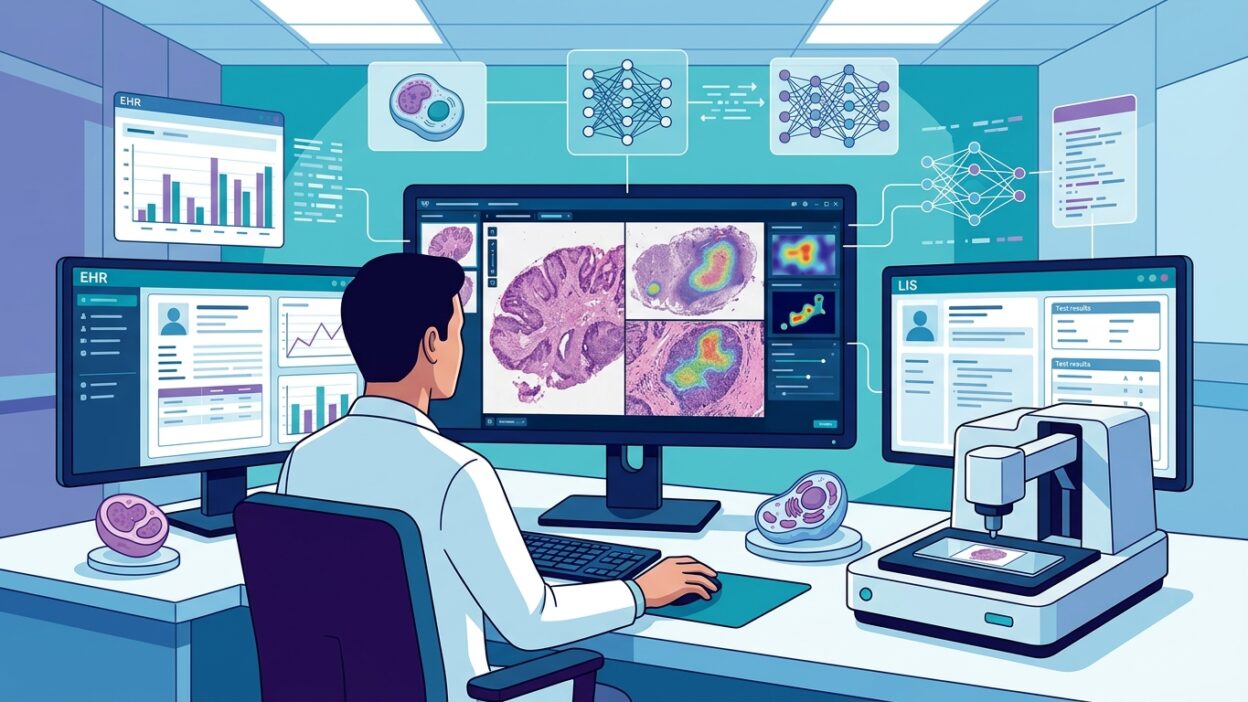
Imagine opening a new case and not having to jump between a WSI viewer, the LIS, the electronic health record, older images, and a separate AI tool. The practical point in Mayo Clinic and Techcyte’s Fusion AP announcement is that these pieces are being pulled into one working environment.
Mayo Clinic and Techcyte announced the implementation of Anatomic Pathology technology developed through a co-development and intellectual property licensing agreement between the two organizations. The July 15, 2026 announcement describes a platform that brings WSI viewing, case information, workflow tools, and AI into a connected digital pathology environment.
Fusion AP is more than a WSI viewer
The important distinction is that Fusion AP is not framed as a slide viewer alone. It combines whole-slide image viewing with case information, workflow tools, and AI. That moves the discussion from a narrow question, can we read a slide digitally, to a more operational question: can a pathologist complete diagnostic work inside a connected digital workflow?
According to Mayo Clinic, the platform enables enterprise-wide access to more than 22.6 million current and historical WSIs from Mayo Clinic’s archive. The number matters, but the archive alone is not the whole story. The value appears when a pathologist can review prior images and related clinical context without breaking the workflow or opening multiple systems.
Why EHR and LIS integration matters
Routine diagnosis does not depend on the image alone. The pathologist needs clinical history, laboratory results, case details, and sometimes prior slides or related specimens. If those details live in separate systems, the digital workflow becomes another layer on top of existing fragmentation.
Fusion AP is integrated with Mayo Clinic’s electronic health record and Laboratory Information Systems. That means the WSI is reviewed alongside relevant patient history, lab results, and case information. For any lab planning digital pathology, this is a central lesson: the scanner is only one part of the value. The slide has to be connected to clinical and laboratory context.
Where AI fits
The announcement refers to AI-enabled tools and a connected AI-driven ecosystem. The practical message is not that AI replaces the pathologist. It is that AI tools become reachable inside the same workflow rather than sitting in a separate application that requires export, import, or manual steps.
This is an operational issue. Many AI tools struggle to enter daily practice because they sit in the wrong place in the workflow. If the pathologist has to leave the reporting environment to use the tool, adoption drops. If the tool is connected to the image, case, LIS, and clinical data, it becomes closer to a routine step in case review.
What other laboratories can take from this
Mayo Clinic is a large institution with data, infrastructure, and resources that most laboratories do not have. This should not be read as a ready-made blueprint for every lab. It does show where the market is moving: digital pathology is shifting from viewing images to platforms that connect images, data, daily work, and AI tools.
For small and mid-sized laboratories, the practical lesson is that platform selection should not start with the viewer interface alone. Labs need to ask about LIS integration, access to prior cases, workflow management, support for AI tools, QA, and turnaround time.
The regulatory detail matters
The announcement states that Techcyte’s anatomic and clinical pathology platform is for Research Use Only in the United States. That sentence should not be ignored. Having AI, WSI, and integration in one platform does not automatically mean every diagnostic use is cleared or ready for routine clinical deployment. Laboratories still need to separate research use, internal validation, and regulated clinical use according to their local rules.
The bottom line for pathologists: the next phase of digital pathology is not just a screen for WSI viewing. It is a case environment that connects the digital slide with the EHR, LIS, archive, and AI tools. Without that connection, digital transformation remains incomplete no matter how good the scanner is.