

The agreement and its scope
PathAI and the MedStar Health system announced a multi-year strategic collaboration to deploy the AISight® Dx digital pathology platform and a set of AI algorithms across MedStar’s multisite laboratory network. The platform has FDA clearance for primary diagnosis in the United States and CE-IVD marking in the European Economic Area, the United Kingdom, and Switzerland.
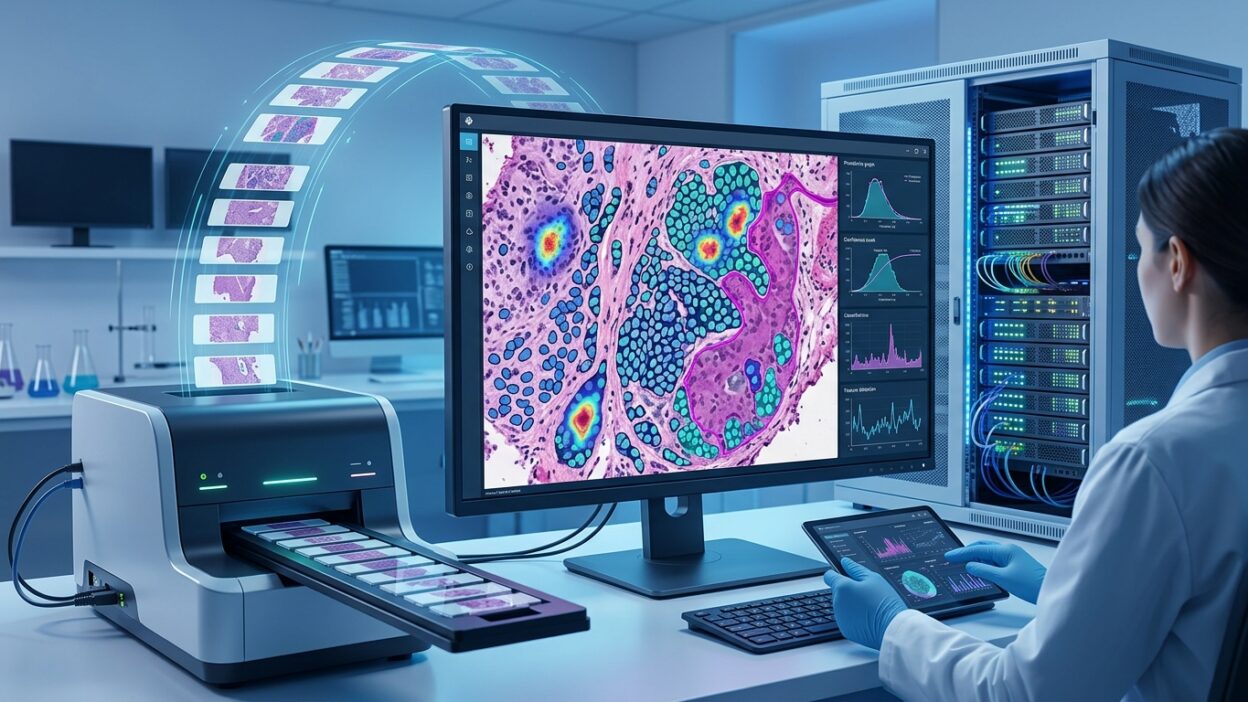
The partnership includes deployment of the ArtifactDetect algorithm and the TumorDetect tool across a network that supports more than 40 pathologists. ArtifactDetect works as a workflow tool on the AISight Dx platform, while TumorDetect is still intended for research use only.
What this step means for pathologists
This deployment follows MedStar’s participation in PathAI’s early access program, along with earlier research that included an independent evaluation of PathAI’s AIM-HER2 Breast algorithm. The platform is therefore not being introduced in isolation. It builds on prior clinical experience and documented validation work.
In daily practice, pathologists care about three practical issues: image quality, speed of access, and fit with existing workflow. AISight Dx is designed as a cloud-native image management system with direct integration of AI algorithms. That differs from the older approach of adding AI as an external layer on top of an existing system.
Comments from medical leadership
Dr. Moira Larsen, medical director of MedStar Medical Group Pathology, said: “At MedStar, we are focused on expanding high-quality care across a large and growing health system, including rapidly expanding outreach work, and digital pathology enables us to carry out that mission.”
Larsen also described the deployment as an infrastructure update that makes MedStar “more connected, more efficient, and better equipped to bring innovative diagnostics into everyday practice.”
Nick Brown, chief growth officer at PathAI, said the collaboration builds “modern digital infrastructure that will accelerate innovation.”
The Precision Pathology Network and research prospects
The partnership sets the stage for further collaboration within PathAI’s Precision Pathology Network. It gives MedStar a route to participate in joint research initiatives, generate real-world multimodal data, support clinical trials and biopharma partnerships, and co-develop advanced AI diagnostics.
For pathologists working in large institutions, this model raises a practical question: is it better to adopt an integrated platform that combines slide management and AI algorithms in one system, or to assemble tools from multiple vendors? The answer depends on the size of the institution and the maturity of its digital infrastructure.
The wider context
MedStar Health is a nonprofit health system covering Maryland and the Washington, DC region. It includes 10 hospitals, 30,000 employees, and 6,000 physicians. It is also the academic and clinical partner of Georgetown University, where more than 1,100 medical residents are trained each year.
This partnership comes as the digital pathology market moves from experimentation to broad real-world deployment. The challenge is no longer only to prove that digital pathology can work. For large systems, the harder question is which platform and partner can support a durable deployment that scales with institutional needs.
What it means for daily practice
For pathologists following this field, several practical points deserve attention:
- AISight Dx has FDA clearance for primary diagnosis, which makes it an approved option for full clinical use, not just research or secondary review.
- Deployment of ArtifactDetect across more than 40 pathologists will generate real-world use data that can show how the tool performs in an actual clinical setting.
- MedStar’s participation in the Precision Pathology Network gives its pathologists a route into advanced research and clinical trials.
The open question is whether partnerships of this type will produce measurable improvements in diagnostic turnaround time and accuracy in daily practice, or whether the benefits will remain mainly at the institutional level. More outcomes data over the coming months should make that clearer.