

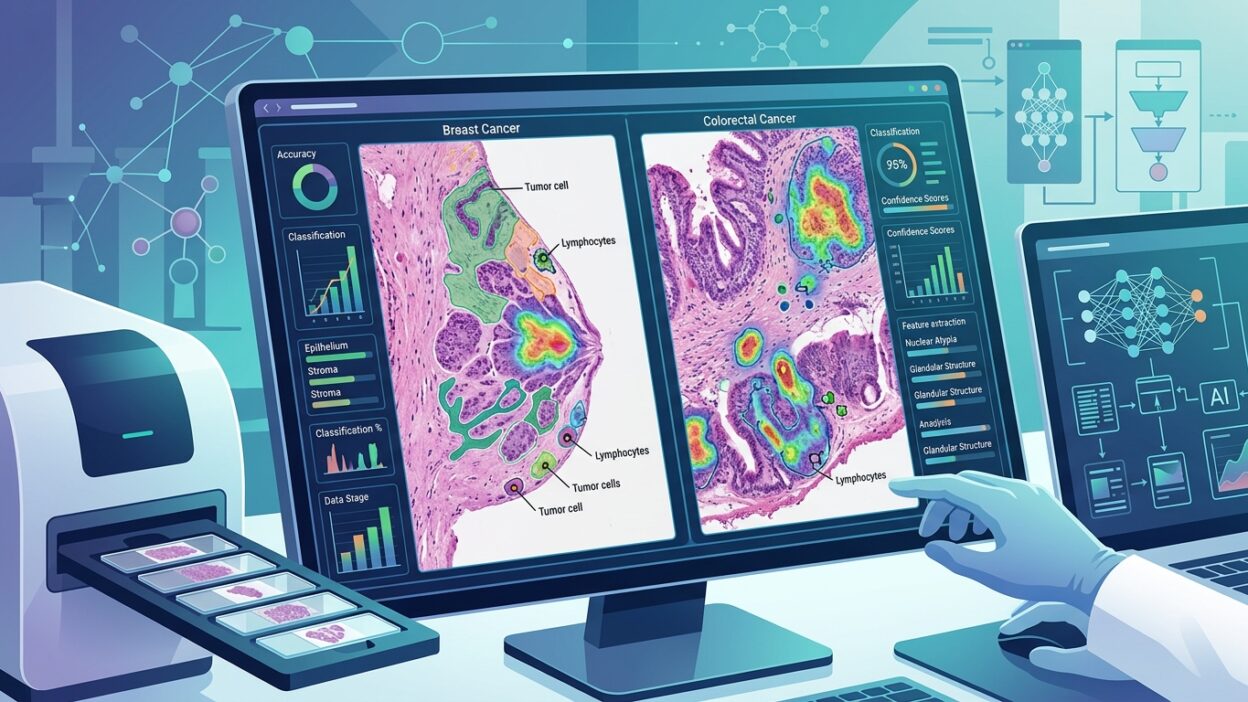
Two tests receive IVDR clearance for clinical deployment in Europe
Waiv, formerly Owkin Dx, has received CE marking under the In Vitro Diagnostic Medical Devices Regulation (IVDR) for two tests: RlapsRisk® BC, which predicts recurrence risk in breast cancer, and MSIntuit® CRC, which screens for microsatellite instability (MSI) in colorectal cancer.
The clearance allows both tests to be used in clinical practice across European Union countries.
RlapsRisk BC: recurrence-risk stratification from H&E slides
RlapsRisk BC works on standard histology-stained slides. The model analyzes the digital image and provides a recurrence-risk assessment at a level close to genomic profiling, without the need for additional molecular testing.
The practical use is straightforward. The pathologist reads the routine slide, and the model adds a layer of information about the likelihood of recurrence. Patients at higher risk can be directed toward more intensive treatment. Patients at lower risk may avoid treatment they may not need.
This addresses a real problem in daily practice. Genomic risk assessment requires sending the sample to a specialized laboratory, with extra time and higher cost. When the assessment is available from the same slide the pathologist already reads, the calculation of cost and turnaround time changes completely.
MSIntuit CRC: MSI screening from routine histology
MSIntuit CRC provides an initial screen for MSI status from H&E slides. The immediate aim is to rule out negative cases quickly. This reduces the burden on conventional IHC and PCR testing for MSI confirmation and limits those tests to the cases that need them.
MSI status is clinically important for identifying patients who may be candidates for immunotherapy. Faster screening means faster access to the right treatment. In a laboratory handling hundreds of colorectal cancer samples each year, avoiding IHC or PCR for a portion of samples makes a measurable difference to workflow.
IVDR versus IVDD: why this clearance is different
IVDR imposes stricter requirements than its predecessor, IVDD. These include broader clinical evidence, continuous performance verification, and post-market surveillance. The company conducted a broad clinical evaluation using multimodal data from a large network of institutions in Europe.
Meriem Sefta, chief executive officer and co-founder, said: “Receiving CE-IVD marking under IVDR is a key moment for Waiv. This certification reflects the scientific and clinical work behind our models and the sustained effort to turn AI innovation into products that can affect patient care.”
AI models in histopathology often face a gap between research performance and real clinical performance. The value of IVDR here is that it requires evidence from multiple clinical settings that extend beyond the training data. This strengthens confidence that the model will perform as expected outside the development environment.
Availability and integration with laboratory systems
The two tests are available through the Destra® platform, or through direct integration with compatible information management systems. Supported systems include Proscia, Roche Diagnostics, Sectra, and Tribun Health.
This means a laboratory using one of these systems can add the two tests without changing its infrastructure. The technical threshold for adoption is low.
Funding and background
Waiv has raised $33 million in seed funding from OTB Ventures, Alpha Intelligence Capital, and other investors. The company built its work on seven years of developing validated medical AI models and on one of the largest multi-institutional data networks in Europe.
Existing collaboration with global pharmaceutical companies and research institutions suggests that the two tests will be used in drug development as well as routine clinical diagnosis.
What does this mean for pathologists in practice?
Two points.
First: both tests work on H&E slides. No additional preparation, no special stains. The laboratory sends the routine slide and the model runs on it.
Second: integration with systems that are already in place. A laboratory using Proscia, Sectra, or the other supported systems does not need new infrastructure.
The harder question is clinical: how will the results of these tests fit into decision-making for each patient? Actual practice and field data will answer that. The clearance opens the door, but adoption will depend on pathologists’ trust in the results and on how useful those results prove to be in the clinic.