

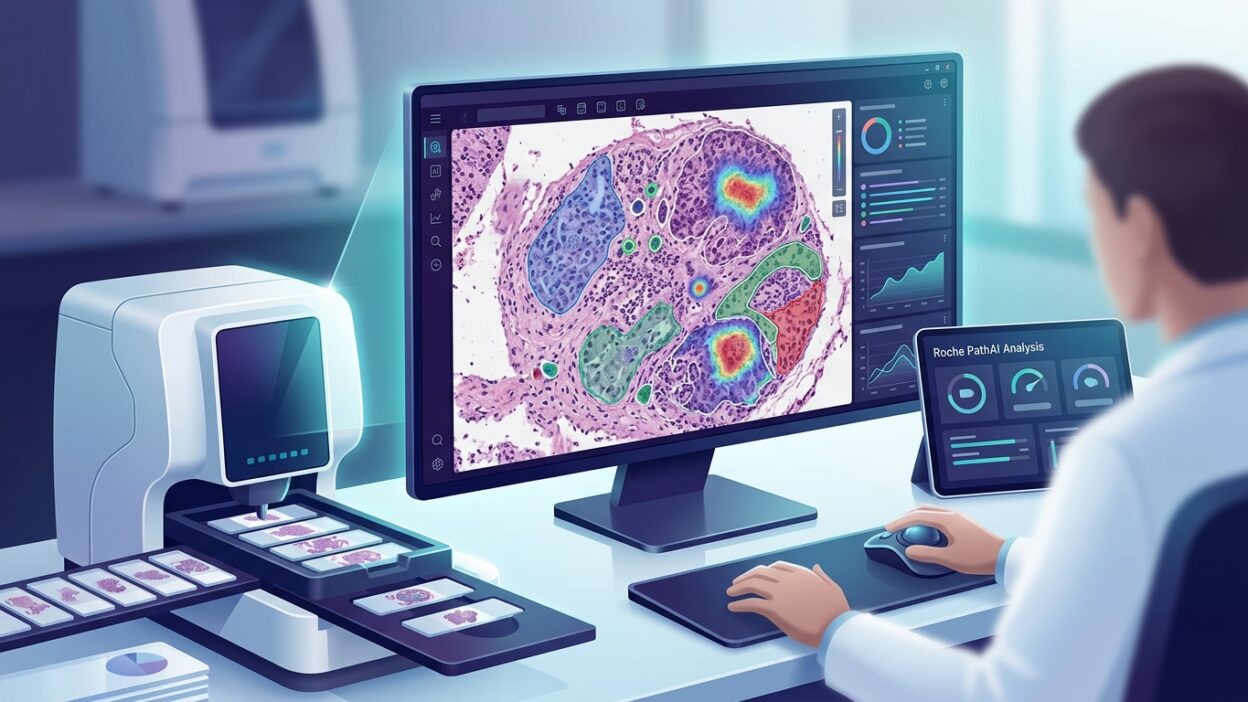
Roche’s agreement to acquire PathAI, pending completion of closing conditions, is not only a financial story about one company. For pathologists, it puts a practical question on the table: how will artificial intelligence move from an added layer on top of WSI platforms to a component built into the diagnostic system itself?
Andrew Beck, PathAI’s co-founder and CEO, wrote about the path that led to this agreement, from neural-network attempts in pathology images two decades ago, through his team’s win in the 2016 Camelyon challenge, to the use of AISight on hundreds of thousands of slides each month. These details matter because they remind us that clinical adoption does not come from a good model alone. Adoption needs a platform, data, quality control, laboratory integration, and clear responsibility when an error occurs.
The value is in integration, not AI noise
In recent years, PathAI has built a clear presence in two tracks: drug development and clinical diagnostics. In drug development, products such as AIM-MASH AI Assist have had a notable regulatory path after qualification by the EMA and FDA for use in MASH trials. In diagnostics, AISightDx received FDA 510(k) clearance for primary digital diagnosis, with a predetermined change control plan for the IMS system. That last point means a lot to anyone working inside a real laboratory, because every update in a digital imaging system or assistive algorithm raises questions about validation, documentation, and risk management.
Roche’s presence changes the nature of the question. Roche is not a software startup looking for a foothold in laboratories. It has a long relationship with diagnostic instruments and reagents, and experience linking tests to treatment pathways, especially in oncology. If the acquisition is completed, some of PathAI’s work may move from an external solution into a position closer to the diagnostic infrastructure the laboratory uses every day.
That does not make the road short. Pathology laboratories do not adopt new tools simply because a large company stands behind them. The decision passes through boring but decisive questions: does the system work with the current specimen flow? Does it add time or reduce it? How does it handle differences in stains, scanners, and sites? Who reviews borderline cases? And how do we prevent the algorithm from becoming a black box that pressures the pathologist’s decision instead of supporting it?
An important lesson from the history of AI in pathology
The original text goes back to PAPNET, ThinPrep, and image-analysis experiments in cytology, then to C-Path attempts in breast cancer. This sequence is not technical nostalgia. The lesson is that pathology saw early automation attempts before the surrounding infrastructure had matured. There were good research results, but the move into daily use ran into tissue preparation, specimen variability, and the need for continuous system calibration.
Several conditions have changed today. WSI images are more present in clinical work. Storage and computing are less of a barrier than they used to be. Deep models can handle visual patterns that older tools could not. But the hardest barrier has not disappeared: professional trust. A pathologist does not need a tool that only produces an attractive number in a paper. The pathologist needs a tool they know when to rely on and when to ignore.
For this reason, I think the Roche and PathAI news should be read through governance as much as through performance. Success will not be measured by the number of published models, but by the number of clinical scenarios that can be run, reviewed, updated, and defended before quality teams and regulators.
What could change inside the laboratory?
The first possible area of change is work triage and prioritization. When a digital platform handles a large volume of slides each month, case ordering, detection of high-risk cases, and directing attention to specific regions become daily questions. This kind of support may be more acceptable than tools that try to issue a complete diagnostic judgment from the start.
The second area is quantitative measurement in defined therapeutic contexts. In oncology, everyone knows that the value of a tool is not in its ability to color a pretty heatmap. Its value is in reducing inter-reader variability, improving consistency across sites, and linking the result to a clear treatment decision. Roche has both commercial and scientific reasons to care about this, because companion diagnostics depend on a measurement that can be defended.
The third area is translational research. If PathAI’s tools move closer to Roche’s diagnostic and pharmaceutical networks, we may see stronger links among tissue images, clinical-trial results, and treatment response. This is an attractive area, but it needs caution. Tissue carries rich information, but turning it into clinically usable markers requires careful study design, not training a model on a large archive and then searching for a convincing story afterward.
What should pathologists ask for?
The good news is that the pathologist’s position has not weakened. The opposite is closer to the truth. The closer AI gets to the final report, the greater the need for a professional eye that understands the specimen, the clinical context, and the limits of measurement. Laboratories should therefore be clear about their requirements when assessing any platform from PathAI, Roche, or others.
We need local validation data, not only general numbers. We need performance reports broken down by organ, specimen type, preparation method, and scanner. We need a clear update log showing what changed in the model after each update. And we need an interface that does not force the pathologist to accept the algorithm’s output, but makes review faster and more accurate.
There is another requirement that gets less attention: training. Pathologists need to be trained to read the tool’s outputs the way they read IHC or a molecular report, rather than settling for general lectures about what artificial intelligence means. What are the limits of the signal? What are the sources of error? When is the result not interpretable? These questions should enter departmental discussions, not remain with information-technology teams.
The acquisition may accelerate the market, but it does not remove the duty to evaluate
Roche’s move may push other companies to strengthen their digital pathology and AI offerings. We may see more partnerships among device companies, pharmaceutical companies, and WSI analysis platforms. That is useful if it leads to better and more usable products. But it may also create marketing pressure on laboratories that have not yet completed the basics of digital transformation.
Pathologists should respond calmly and firmly. Clearance in one context is not enough to make a tool suitable for every laboratory. Performance in a large center does not guarantee performance in a mid-sized laboratory using a different scanner and a different specimen flow. Local validation protects the patient and the pathologist, and it should not be treated as extra paperwork.
The phrase Beck used in the title, that the term “AI-powered digital pathology” will soon sound quaint, deserves a careful reading. AI may become invisible inside the platform, just as many software layers have become invisible to the user. But the disappearance of the name does not mean the disappearance of responsibility. In the final report, the question will remain the same: is the result correct, interpretable, and useful for the patient?
Source: Pathology News.