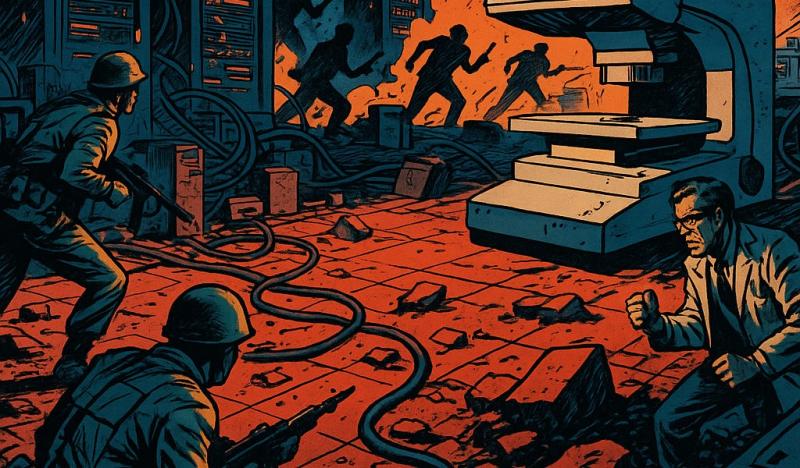
The work of a pathologist is usually associated with tranquility: an isolated lab, a microscope, and deep concentration. But what happens when this tranquility collapses? In times of war, natural disasters, or suffocating crises, the scales tip. Roads are cut off, reagents run out, and the movement of patients or doctors to the hospital becomes a perilous adventure.
In our region, unfortunately, we understand this reality well. Under these circumstances, cancer does not wait for a truce, and tumors do not stop growing because supply chains are halted. This is precisely where the mask falls from “Digital Pathology” as merely a modern and expensive technology, revealing its true face: an indispensable lifeline.
1. The Fragility of Glass Slides Against Geography
Traditional diagnosis relies entirely on physical movement. The specimen is excised, processed, sectioned, placed on a glass slide, and then manually transported from the lab to the doctor’s office. If the case is complex and requires consultation, the slide is packaged and sent by mail to another doctor in a different city or country.
In times of crisis, this chain collapses. Glass slides are fragile, breakable, and mail services cease.
Digital pathology eliminates the need for physical slide transport. Once a slide is scanned at the nearest available center, the specimen transforms into data that crosses borders, checkpoints, and distances in seconds. A pathologist in a safe area can diagnose a case for a patient in a besieged region, without delay.
2. Overcoming “Brain Drain”
One of the silent repercussions of wars and economic crises is the emigration of specialized medical professionals, especially pathologists, who already suffer from a global shortage. Hospitals in conflict zones suddenly find themselves without experts to diagnose complex cases.
Digitization fundamentally solves this dilemma through Telepathology. A pathologist forced to leave the country due to compelling circumstances can continue to cover hospital work and deliver diagnoses daily via the internet. A field or local hospital only needs a technician to prepare the slide and a scanner, while the diagnostic expertise can be anywhere in the world. This maintains the continuity of healthcare and prevents the collapse of the system.
3. Protecting Medical Memory: Archive Loss
Every pathology lab possesses a vast archive of glass slides and paraffin blocks. This archive is not just history; it is a vital reference for tumor patient follow-up or when a patient experiences a relapse years later.
In numerous crises, we have seen how major hospitals were destroyed, and with them, decades-old archives were burned or damaged. A patient returning with a new tumor finds their histological history completely erased.
Digital pathology, supported by cloud storage, makes medical memory impervious to physical destruction. Even if an entire building collapses, patient files and their digital slides remain secure, accessible, and ready for retrieval from any access point.
4. Managing Scarce Resources and Artificial Intelligence
In times of crisis, laboratories suffer from a severe shortage of immunohistochemistry (IHC) reagents and essential supplies. Cases also accumulate due to staff shortages.
Here, digital pathology intervenes as a crisis management tool:
- Automated Triage: AI algorithms can quickly examine and sort digital slides, prioritizing critical cases (such as rapidly growing malignant tumors) at the top of the pathologist’s worklist, thereby saving the lives of patients who cannot afford the luxury of waiting.
- Waste Reduction: Virtual staining techniques, now maturing, can provide an alternative when chemical supplies are interrupted, allowing diagnostic information to be extracted from H&E slides without the need for expensive and unavailable additional stains.
Conclusion: Investing in Prosperity in Anticipation of Adversity
The most important lesson we learn from crises is that digital infrastructure is not a luxury to be pursued when there is a budget surplus, but rather an essential line of defense that must be built before disaster strikes.
Investing in scanners, training technicians in digitization, and establishing remote diagnostic networks is what ensures that cancer patients are not left to face their fate alone when the wheels of life outside come to a halt.
Glass breaks, and buildings may fall, but data — and life-saving diagnoses — must continue to flow.