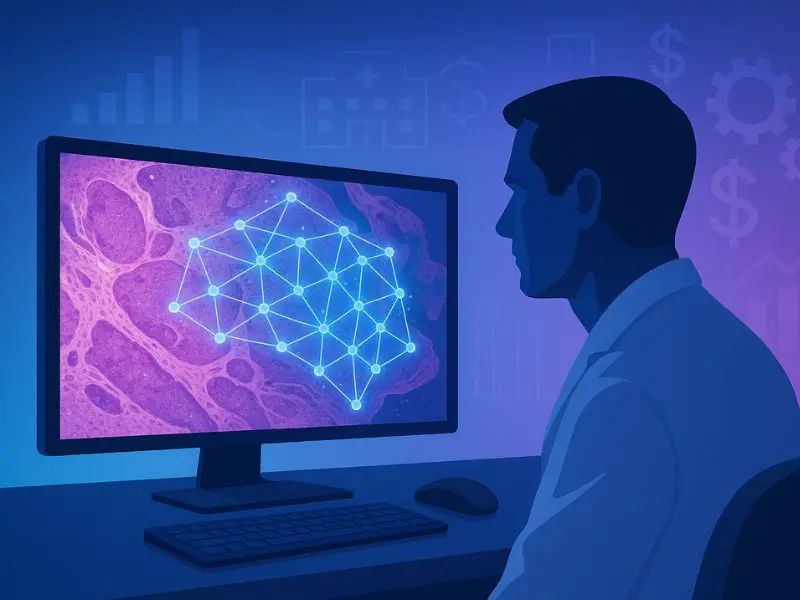
In recent years, it has become clear that Artificial Intelligence (AI) is no longer just a futuristic concept in medicine. Today, it is already transforming the practice of pathology, from cancer diagnosis to optimizing laboratory workflows.
One of the most notable recent lectures was by Professor David Klimstra from Yale University (and a co-founder of Paige AI), who illustrated how AI is not only changing the scientific aspect of pathology but also opening new avenues at the strategic and business levels.
How is AI changing diagnosis?
In prostate cancer: AI-powered systems have reduced error rates by up to 70% and increased diagnostic accuracy even among less experienced pathologists.
In breast cancer: Invasive tumors, atypical hyperplasia (atypia), and ductal lesions can be identified with high accuracy, while accelerating challenging tasks such as mitotic counting and detecting lymph node metastases.
Here, it is clear that the goal is not to replace pathologists, but to enhance their work by reducing variability, increasing speed, and delivering more consistent results.
Digitization is the Gateway
Glass slides alone are not enough. The path to AI begins with digital pathology: scanning slides and converting them into high-resolution images that can be archived, shared, and computationally analyzed.
However, challenges remain:
Cost of digital scanners.
Lack of reimbursement.
Poor integration between different systems.
Without overcoming these obstacles, widespread AI adoption will remain limited.
Practical Impact within the Lab
“Time and motion” studies indicate that pathologists spend one-third of their time reviewing slides and another third writing reports. AI systems can reduce non-productive time, allowing pathologists more room to focus on complex diagnostic decisions.
For example:
Lymph node review in breast cancer cases has been halved thanks to AI.
In prostate biopsies, missed case rates have significantly decreased, with improved consistency between general and specialized pathologists.
New Business Opportunities
AI not only offers diagnostic solutions but also economic opportunities:
Discovering biomarkers directly from H&E slides instead of costly molecular tests.
Classifying rare tumor patterns to support personalized medicine.
Contributing to clinical trials by selecting appropriate patients.
With the emergence of Foundation Models, developing these applications will become faster and less costly, often available as a software update rather than requiring massive investments.
What should pathology departments do?
Invest in digital infrastructure (scanners + integrated LIS).
Evaluate AI systems for accuracy, integration, and regulatory compliance.
Monitor reimbursement and insurance policies.
Engage staff early to build trust and dispel concerns.
Consider new service lines such as remote consultations or advanced testing.
Conclusion
The question is no longer: “Will AI enter the field of pathology?” but rather: “Who will be ready to leverage it first?”
Pathologists who adopt these tools will not be replaced by machines; instead, they will become more accurate, faster, and more valuable in a healthcare system moving towards data and AI.
The future still relies on human expertise, but success will favor those who know how to use AI as a strategic partner, not an adversary.